Making Tax Digital Timeline: Every Key Date from 2022 to 2028
Tax & Compliance Series
This guide is part of a comprehensive series. Explore all 202 topics:
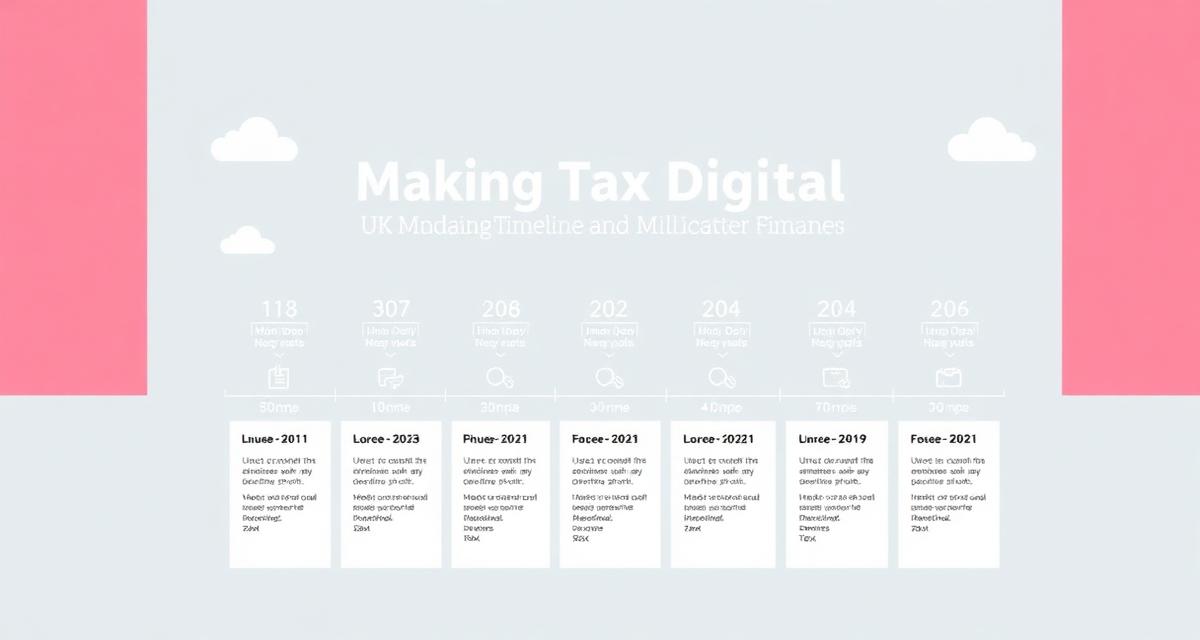
The Complete MTD Timeline
Making Tax Digital is HMRC's multi-year programme to digitise the UK tax system. Here's every important date — past, present, and future.
Making Tax Digital is HMRC's multi-year programme to digitise the UK tax system. Here's every important date — past, present, and future.
What's Already Happened
If you're VAT-registered today, you should already be using MTD-compatible software. If you're still filing through the HMRC portal, you're non-compliant.
| Date | Milestone | Who's Affected |
|---|---|---|
| April 2019 | MTD for VAT Phase 1 — mandatory for businesses above £85,000 VAT threshold | ~1.2 million businesses |
| April 2022 | MTD for VAT Phase 2 — mandatory for ALL VAT-registered businesses | All VAT-registered businesses (including voluntarily registered) |
If you're VAT-registered today, you should already be using MTD-compatible software. If you're still filing through the HMRC portal, you're non-compliant.
What's Coming Next
What's Coming Next — April 2026: MTD for Income Tax Self Assessment — Phase 1 — Self-employed individuals and landlords with annual income >£50,000.
| Date | Milestone | Who's Affected |
|---|---|---|
| April 2026 | MTD for Income Tax Self Assessment — Phase 1 | Self-employed individuals and landlords with annual income >£50,000 |
| April 2027 | MTD for ITSA — Phase 2 (lower threshold) | Self-employed/landlords with income >£30,000 |
| TBD (2028–2030) | Potential mandatory B2B e-invoicing (Peppol-based) | All UK businesses |
| TBD | MTD for Corporation Tax | Limited companies — no confirmed date |
MTD for Income Tax: What Changes in April 2026
This is the biggest upcoming change.
This is the biggest upcoming change. If you're self-employed or a landlord with business/property income above £50,000, you'll need to:
- Keep digital records of all business income and expenses using MTD-compatible software
- Submit quarterly updates to HMRC (within 1 month of each quarter end)
- Submit an End of Period Statement (EOPS) — confirming your quarterly figures are complete
- File a Final Declaration — replacing the current Self Assessment tax return
The quarterly deadlines will be:
- Q1 (6 April – 5 July) → submit by 5 August
- Q2 (6 July – 5 October) → submit by 5 November
- Q3 (6 October – 5 January) → submit by 5 February
- Q4 (6 January – 5 April) → submit by 5 May
How to Prepare: Action Checklist
If You're VAT-Registered (Now)
- ✅ Use MTD-compatible software for VAT returns
- ✅ Ensure digital links between all record-keeping systems
- ✅ Review your software annually — HMRC updates requirements
If You're Self-Employed/Landlord with Income >£50,000 (Prepare by April 2026)
- 🔲 Choose MTD for ITSA-compatible software
- 🔲 Set up digital record keeping for income and expenses
- 🔲 Practise quarterly submissions using the HMRC sandbox
- 🔲 Review your bookkeeping habits — quarterly updates need timely records
If You're a Limited Company (Watch and Wait)
- 🔲 No confirmed MTD for Corporation Tax date yet
- 🔲 Continue using digital accounting software as best practice
- 🔲 Prepare for e-invoicing requirements when they're announced
Penalties for Non-Compliance
HMRC has moved to a points-based penalty system for late submissions:
HMRC has moved to a points-based penalty system for late submissions:
- Each late submission earns 1 penalty point
- Reach the threshold (4 points for quarterly filers) → £200 penalty
- Each subsequent late submission → £200
- Points reset after 24 months of compliance
Late payments attract interest at Bank of England base rate + 2.5%.
Should You Wait or Switch Software Now?
Businesses often ask whether it's worth changing software ahead of a deadline that's still a year or more away. In most cases, switching early is the safer choice.
| Approach | Best for | Pros | Cons |
|---|---|---|---|
| Switch to MTD-ready software now | Businesses close to the £50,000 ITSA threshold or already VAT-registered | Time to learn the system before deadlines bite; smoother data migration; avoids a last-minute scramble | Requires upfront setup effort sooner than strictly necessary |
| Wait until closer to the deadline | Businesses well under the £50,000 threshold with stable, simple finances | Avoids paying for software before it's compulsory | Risk of rushed migration, data-entry errors, and missed early submissions once the rule applies |
Sole Traders vs. Landlords Under MTD for ITSA
MTD for ITSA applies to both self-employed sole traders and landlords, but the £50,000 (and later £30,000) threshold is based on combined gross income from all self-employment and property sources, not just one business.
MTD for ITSA applies to both self-employed sole traders and landlords, but the £50,000 (and later £30,000) threshold is based on combined gross income from all self-employment and property sources, not just one business. For example, a landlord with £35,000 in rental income and a sole trader business earning £20,000 would have combined income of £55,000 and fall within Phase 1 from April 2026, even though neither activity alone crosses the threshold.
Frequently Asked Questions
Will MTD for ITSA apply to me if I earn under £30,000?
Not yet. The £30,000 threshold takes effect from April 2027. HMRC has signalled an intention to lower the threshold further in future, potentially to £20,000, but no confirmed date exists for that phase.
Is there a confirmed date for mandatory UK e-invoicing?
No. Industry commentary based on HMRC's Tax Administration Framework Review points to a possible 2028-2030 window for a Peppol-based B2B e-invoicing mandate, but HMRC has not published a firm date.
What penalty applies for missing an MTD quarterly update?
HMRC uses a points-based penalty system. Each late submission earns a point; once quarterly filers reach 4 points, a £200 penalty applies, with a further £200 for each subsequent late submission until points reset after 24 months of compliance.
Does MTD for Corporation Tax have a start date?
No. Unlike MTD for VAT and MTD for ITSA, HMRC has not set a confirmed date for MTD for Corporation Tax. Limited companies should continue using digital accounting software as best practice while waiting for an announcement.
The Bigger Picture: UK E-Invoicing
MTD is step one. Step two is likely mandatory e-invoicing via the Peppol network.
MTD is step one. Step two is likely mandatory e-invoicing via the Peppol network. The government's Tax Administration Framework Review has laid the groundwork, and alignment with EU standards (EN 16931) is expected. Businesses that adopt digital invoicing now will have a smoother transition when B2B e-invoicing becomes mandatory.
More in this series (202 articles)
From this series
Stay audit-ready and compliant with tax regulations across different regions.
Related Topics
Digital Marketing, SEO Specialist, Content Creator & Product Professional
Olayinka is a digital marketer, content creator, growth and SEO specialist with 10+ years helping businesses in Nigeria, the UK, the US, Australia, and Dubai achieve their goals online.