ZATCA Phase 1 vs Phase 2: What Changes When You Integrate (2026)
Global E-Invoicing Platform Series
This guide is part of a comprehensive series. Explore all 36 topics:
The Saudi Fatoorah programme has two phases. Phase 1 (Generation, since December 2021) requires structured, tamper-resistant invoices and a five-tag TLV QR on B2C documents. Phase 2 (Integration, since January 2023, wave-based) adds a state-issued CSID, XAdES B-B signing, a SHA-256 hash chain, real-time clearance for B2B Standard Tax Invoices, 24-hour reporting for B2C Simplified Tax Invoices, and four extra QR tags for the cryptographic stamp.
At a glance
- Authority: ZATCA — both phases
- Phase 1: Generation, structured invoice + B2C QR, no transport
- Phase 2: Integration, UBL 2.1 KSA + XAdES + hash chain + clearance/reporting
- Migration trigger: ZATCA wave notification (six-month window)
- Common base: sequential numbering, immutability, six-year archive, penalty schedule
- Last reviewed: 23 June 2026 against ZATCA Roll-out Phases page
Macro context — same regulator, two layers
ZATCA designed the two phases to be additive, not substitutive.
ZATCA designed the two phases to be additive, not substitutive. Phase 1 controls (structure, sequence, immutability, B2C QR, six-year archive) remain in force throughout — Phase 2 adds the cryptographic and transport layer on top. A taxpayer that built Phase 1 sloppily (editable spreadsheets, gappy numbering, no UBL payload) faces a real project for Phase 2; one that built Phase 1 correctly faces a configuration step.
Side-by-side comparison
Side-by-side comparison — Live since: 4 December 2021 — 1 January 2023 (Wave 1).
| Aspect | Phase 1 — Generation | Phase 2 — Integration |
|---|---|---|
| Live since | 4 December 2021 | 1 January 2023 (Wave 1) |
| Rollout | All VAT-registered, simultaneously | Wave-based, six-month notice |
| Structured payload | Required (schema unspecified) | Required (UBL 2.1 KSA profile) |
| Tamper-resistance | Required | Required |
| Sequential numbering | Required (invoice number) | Required (ICV per Solution Unit, no gaps) |
| Hash chain (PIH) | Not required (recommended) | Required — SHA-256 chained per Solution Unit |
| Signing certificate | None | CSID issued by ZATCA per Solution Unit |
| Cryptographic signature | None | XAdES B-B applied after canonicalisation |
| QR on Simplified (B2C) | Required — 5 TLV tags | Required — 9 TLV tags (adds crypto-stamp) |
| QR on Standard (B2B) | Not required | Required |
| Transport to ZATCA | None (offline) | Clearance (B2B real-time) / Reporting (B2C <24 h) |
| Buyer delivery (B2B) | Direct from seller | Only after ZATCA clearance returns |
| Archive | 6 years, immutable | 6 years, immutable (+ cleared response) |
| Penalty schedule | Shared | Shared |
How the QR changes between phases
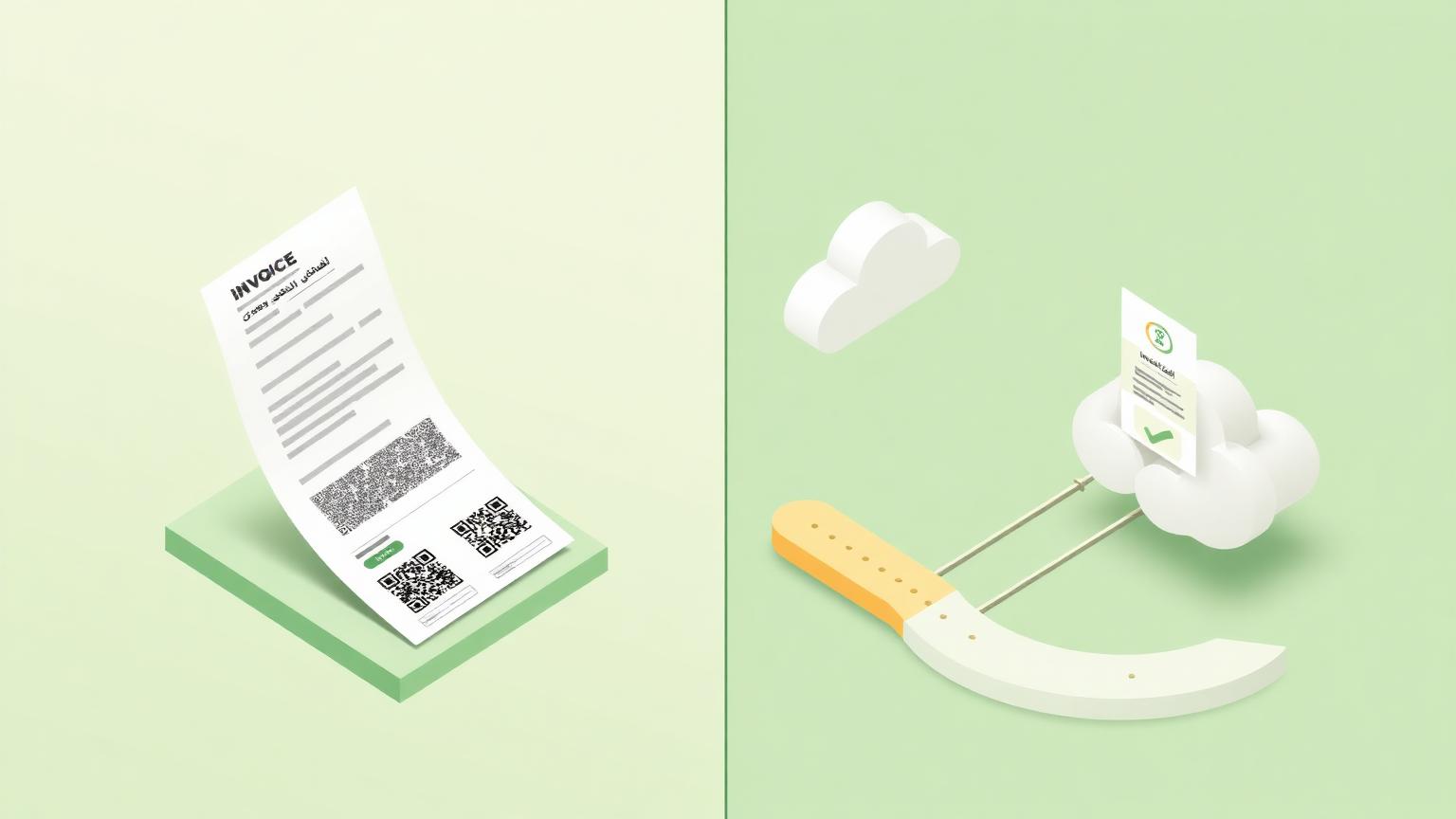
Phase 1 QR has five tags: seller name, VAT number, timestamp, total with VAT, VAT amount. Phase 2 adds four more: invoice hash, cryptographic stamp, public key, and (for Standard Tax Invoices) the signature of the public key.
Phase 1 QR has five tags: seller name, VAT number, timestamp, total with VAT, VAT amount. Phase 2 adds four more: invoice hash, cryptographic stamp, public key, and (for Standard Tax Invoices) the signature of the public key. The same Base64-TLV encoding, but length-byte calculation on UTF-8 still trips up implementations on Arabic seller names — see ZATCA Phase 2 common errors for the catalogue.
How the issuance flow changes
Phase 1 issuance flow
- Sales event in ERP/POS.
- EGS allocates the sequential invoice number atomically.
- EGS renders structured payload (UBL 2.1 recommended) + PDF/A-3 + (B2C) TLV QR.
- EGS persists invoice in immutable storage.
- EGS delivers to buyer directly.
Phase 2 issuance flow
- Sales event in ERP/POS.
- EGS allocates ICV atomically per Solution Unit.
- EGS renders UBL 2.1 KSA-extension XML; computes invoice hash; chains to previous (PIH).
- EGS applies XAdES B-B signature with Production CSID after canonicalisation.
- EGS embeds 9-tag TLV QR (Phase 1 tags + crypto stamp).
- Standard (B2B): POST to Clearance API → receive cleared invoice → deliver to buyer.
- Simplified (B2C): deliver to buyer immediately → POST to Reporting API within 24 hours.
- EGS persists invoice + cleared response in immutable storage.
Migration playbook (Phase 1 → Phase 2)
Migration playbook (Phase 1 → Phase 2) includes: Confirm wave on Fatoora. The official notification names you and starts the six-month clock.
- Confirm wave on Fatoora. The official notification names you and starts the six-month clock.
- Onboard the Solution Unit. Generate CSR → request OTP → exchange for Compliance CSID → pass compliance checks → promote to Production CSID. Full flow in How to comply with ZATCA Phase 2.
- Upgrade the payload. If you persisted UBL 2.1 in Phase 1, add the KSA extensions and the ProfileID; if not, schema-migrate the issuance pipeline now.
- Initialise the hash chain. If you stored PIH in Phase 1, the chain continues. If not, the chain starts fresh from the first cleared invoice under the new CSID.
- Switch transport. Wire the Clearance API for B2B and the Reporting API for B2C; gate B2B buyer delivery on cleared response.
- Extend the QR. Add the four crypto-stamp tags to Simplified, and add the QR to Standard.
- Update the archive. Store the cleared response (or reporting acknowledgement) alongside the XML and PDF/A-3.
Pre-Phase-2 checklist (run during your six-month window)
Pre-Phase-2 checklist (run during your six-month window) includes: ☐ UBL 2. 1 KSA-extension XML produced for every invoice.
- ☐ UBL 2.1 KSA-extension XML produced for every invoice.
- ☐ Production CSID installed per Solution Unit.
- ☐ Compliance certificate purged from production keystore.
- ☐ All four invoice/note types tested end-to-end against the sandbox.
- ☐ Hash chain (PIH) live; ICV gap-free.
- ☐ B2B buyer delivery gated on cleared response.
- ☐ B2C reporting job runs at least every 60 minutes.
- ☐ 9-tag QR generated and verified with ZATCA's decoder.
- ☐ Six-year archive policy extended to include cleared responses.
Key takeaways
Key takeaways includes: Phase 2 is additive: every Phase 1 control remains, and the cryptography + transport layer is bolted on top. The QR grows from 5 to 9 tags; B2B invoices gain a QR for the first time.
- Phase 2 is additive: every Phase 1 control remains, and the cryptography + transport layer is bolted on top.
- The QR grows from 5 to 9 tags; B2B invoices gain a QR for the first time.
- B2B is now cleared before delivery; B2C is reported within 24 hours.
- The migration is a project if Phase 1 was sloppy and a configuration step if Phase 1 was done right.
Authority sources
- ZATCA — Roll-out phases
- ZATCA — Detailed Guidelines for E-Invoicing v2 (PDF)
- ZATCA — Detailed Technical Guidelines (PDF)
- ZATCA — E-Invoice specifications
- ZATCA — How to prepare for Phase 2
- ZATCA — E-invoicing FAQ (PDF)
Related reading
Implementation guides: How to comply with Phase 1 and How to comply with Phase 2. Rule-set explainers: Phase 1 explained and Phase 2 explained.
Implementation guides: How to comply with Phase 1 and How to comply with Phase 2. Rule-set explainers: Phase 1 explained and Phase 2 explained. Debugging: Common errors. Product pages: /e-invoicing/zatca-phase-1 and /e-invoicing/zatca-phase-2.
More in this series (36 articles)
From this series
Mandate-compliant e-invoicing in 17 jurisdictions, with the local artefact (CSID, IRN, UUID, QR, digital signature) issued automatically.
Digital Marketing, SEO Specialist, Content Creator & Product Professional
Olayinka is a digital marketer, content creator, growth and SEO specialist with 10+ years helping businesses in Nigeria, the UK, the US, Australia, and Dubai achieve their goals online.