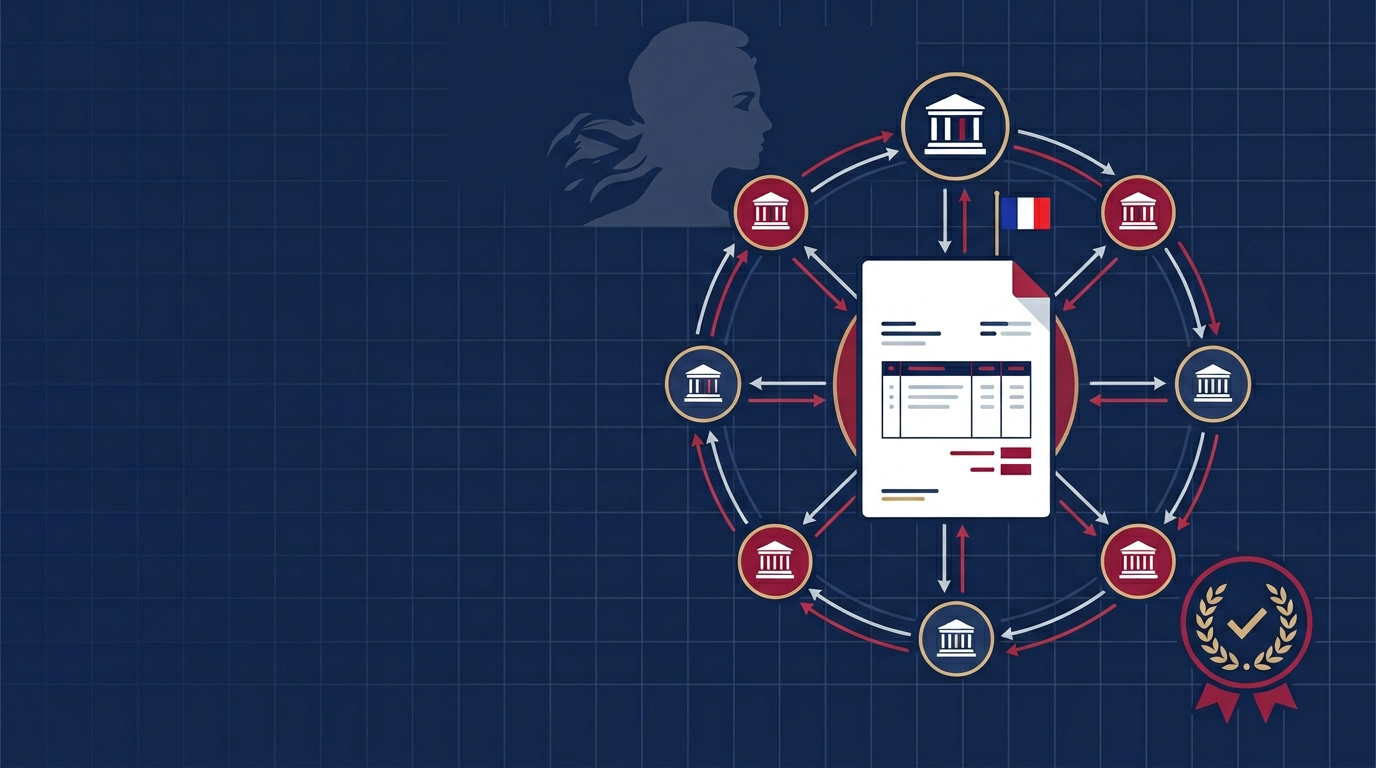
France E-Invoicing Guide: PPF, PDP & e-Reporting Mandate (2026)
Tax & Compliance
Stay audit-ready and compliant with tax regulations across different regions.
Tax & Compliance Series
This guide is part of a comprehensive series. Explore all 202 topics:
France's e-invoicing mandate launches September 1, 2026, requiring every VAT-registered business to receive structured e-invoices, with large enterprises also required to emit them. Mid-size and micro-enterprises must emit from September 1, 2027. The system uses a Y-scheme between the public PPF platform and certified private PDPs, with Factur-X, UBL 2.1, or CII as accepted formats. Non-compliance: €15 per missing e-invoice or e-reporting transaction, capped at €15,000 per year per category, per DGFiP guidelines.
What Is France's E-Invoicing and E-Reporting Mandate?
France is implementing a comprehensive e-invoicing and e-reporting mandate to modernize its tax administration, combat VAT fraud, and streamline business processes. This initiative, governed by the Direction Générale des Finances Publiques (DGFiP), requires businesses to issue and receive electronic invoices and to report transaction data electronically. The mandate is based on the Finance Law 2024, subsequently amended by Finance Law 2026, and is set for a phased rollout beginning September 1, 2026. This system mandates the use of specific electronic formats like Factur-X, UBL 2.1, or CII, and routing through certified platforms.What is the Primary Goal of the French Mandate?
the Primary Goal of the French Mandate includes: Reduce VAT Fraud: Real-time or near real-time data allows for quicker detection of discrepancies. Simplify VAT Declaration: Pre-filled VAT declarations for businesses can reduce administrative burden.
The core objective of the French e-invoicing and e-reporting mandate is to enhance the transparency and efficiency of VAT collection. By standardizing invoice formats and centralizing transaction data, the DGFiP aims to:- Reduce VAT Fraud: Real-time or near real-time data allows for quicker detection of discrepancies.
- Simplify VAT Declaration: Pre-filled VAT declarations for businesses can reduce administrative burden.
- Improve Economic Competitiveness: Digitalization can optimize business-to-business (B2B) exchanges.
- Enhance Data Analytics: The DGFiP can leverage aggregated data for economic insights.
What is the Scope of the French E-Invoicing Mandate?
The French e-invoicing mandate applies broadly to nearly all businesses operating in France subject to VAT. It distinguishes between Business-to-Business (B2B) transactions and Business-to-Consumer (B2C) or international B2B transactions, each with specific reporting requirements.Who is Affected by the B2B E-Invoicing Obligation?
Large enterprises (ETI and grandes entreprises) Mid-size enterprises (PME)
All businesses established in France that are subject to VAT (TVA) and engage in B2B transactions with other French VAT-registered businesses will be affected. This includes:- Large enterprises (ETI and grandes entreprises)
- Mid-size enterprises (PME)
- Micro-enterprises (TPE)
When Does the E-Invoicing Mandate Start for B2B Transactions?
September 1, 2026: All businesses must be capable of *receiving* e-invoices. Large enterprises (ETI and grandes entreprises) must begin *emitting* e-invoices.
The implementation is staggered based on company size:- September 1, 2026: All businesses must be capable of *receiving* e-invoices. Large enterprises (ETI and grandes entreprises) must begin *emitting* e-invoices.
- September 1, 2027: Mid-size enterprises (PME) and micro-enterprises (TPE) must begin *emitting* e-invoices.
What are E-Reporting Obligations for B2C and International Transactions?
E-Reporting Obligations for B2C and International Transactions includes: B2C sales: Transactions made to non-VAT-registered individual customers. International B2B sales: Sales of goods or services to businesses outside of France.
Beyond domestic B2B e-invoicing, France's mandate includes e-reporting for transactions not covered by e-invoicing. This applies to:- B2C sales: Transactions made to non-VAT-registered individual customers.
- International B2B sales: Sales of goods or services to businesses outside of France.
- International B2B purchases: Purchases of goods or services from businesses outside of France (including intra-Community acquisitions and imports).
- Certain exempt transactions: Specific transactions that might be exempt from VAT but still require reporting.
What is the Role of PPF and PDP in France's E-Invoicing System?
France's e-invoicing system operates on a "Y-scheme" model, involving two primary types of platforms: the Portail Public de Facturation (PPF) and Plateformes de Dématérialisation Partenaires (PDP). This dual-platform approach provides flexibility while ensuring compliance and data integrity.What is the Portail Public de Facturation (PPF)?
the Portail Public de Facturation (PPF) includes: Central Directory: Maintaining a directory of all registered businesses and their chosen e-invoicing platform (PPF or PDP). Data Hub: Receiving and transmitting e-invoice data between businesses.
The Portail Public de Facturation (PPF) is the central, public e-invoicing platform provided by the French government (DGFiP). It acts as the backbone of the entire e-invoicing system. All e-invoices and e-reporting data, regardless of the sender's choice of platform, will ultimately pass through or be registered with the PPF. Key functions of the PPF include:- Central Directory: Maintaining a directory of all registered businesses and their chosen e-invoicing platform (PPF or PDP).
- Data Hub: Receiving and transmitting e-invoice data between businesses.
- Tax Authority Interface: Extracting necessary data for VAT pre-filling and tax control purposes for the DGFiP.
- Free Service: Offering a basic, free e-invoicing and e-reporting service for businesses that choose not to use a private PDP.
What are Plateformes de Dématérialisation Partenaires (PDP)?
Plateformes de Dématérialisation Partenaires (PDP) includes: Enhanced Features: Services beyond basic e-invoicing, such as integration with ERP systems, automated reconciliation, electronic archiving, and multiple invoice formats. A good PDP can integrate with your existing invoicing system.
Plateformes de Dématérialisation Partenaires (PDP) are private, certified service providers that offer advanced e-invoicing and e-reporting solutions. Businesses can choose to use a PDP instead of the PPF for their e-invoicing needs. PDPs must be officially registered and certified by the DGFiP. PDPs typically offer:- Enhanced Features: Services beyond basic e-invoicing, such as integration with ERP systems, automated reconciliation, electronic archiving, and multiple invoice formats. A good PDP can integrate with your existing invoicing system.
- Value-Added Services: Support for various business processes, international compliance, and advanced analytics.
- Interoperability: Ensuring seamless communication with other PDPs and the PPF.
- Receiving e-invoices from its clients.
- Ensuring the invoices are in a compliant format (Factur-X, UBL 2.1, or CII).
- Transmitting the invoice data to the recipient's chosen platform (either another PDP or the PPF).
- Extracting mandatory e-reporting data and transmitting it to the PPF.
What are the Key Differences Between PPF and PDP?
What are the Key Differences Between PPF and PDP — Provider: French Government (DGFiP) — Private, certified service providers.
Choosing between the PPF and a PDP depends on a business's needs, volume of transactions, and existing IT infrastructure.| Feature | Portail Public de Facturation (PPF) | Plateformes de Dématérialisation Partenaires (PDP) |
|---|---|---|
| Provider | French Government (DGFiP) | Private, certified service providers |
| Cost | Free of charge for basic services | Subscription fees or transaction-based charges |
| Features | Basic e-invoicing and e-reporting functionalities | Advanced features, ERP integration, archiving, multiple formats, support |
| Compliance | Ensures core compliance with French regulations | Ensures compliance, often with additional features for complex scenarios |
| Integration | Potentially limited direct integration with complex internal systems | Strong integration capabilities with diverse ERP and accounting software |
| Target Audience | Small businesses, those with low transaction volumes, or limited IT resources | Medium to large enterprises, businesses with complex needs, high transaction volumes, or international operations |
What are the Technical Requirements for French E-Invoicing?
To ensure interoperability and data quality, the French e-invoicing mandate specifies strict technical requirements for invoice formats and transmission protocols.What E-Invoice Formats are Accepted?
Factur-X: This is a hybrid format combining a human-readable PDF with an embedded XML data file. It is the preferred and recommended format by the DGFiP due to its dual readability.
The DGFiP has mandated the use of structured electronic formats to ensure machine readability and automated processing. The accepted formats are:- Factur-X: This is a hybrid format combining a human-readable PDF with an embedded XML data file. It is the preferred and recommended format by the DGFiP due to its dual readability. The XML part can be based on the ZUGFeRD or EN 16931 CIUS standard.
- UBL 2.1: Universal Business Language, an international XML standard widely used in e-procurement.
- CII (Cross Industry Invoice): Another international XML standard based on UN/CEFACT syntax.
What Data Must be Included in an E-Invoice?
Invoice number Invoice date
A compliant e-invoice in France must contain specific mandatory information. This generally aligns with standard VAT invoice requirements but also includes specific mandate-related data points. Mandatory fields typically include:- Invoice number
- Invoice date
- Date of service or goods delivery
- Seller's legal name and VAT number
- Buyer's legal name and VAT number
- Description of goods or services
- Quantity and unit price
- Applicable VAT rate (e.g., 20%, 10%, 5.5%, 2.1%)
- VAT amount per rate
- Total invoice amount excluding VAT
- Total invoice amount including VAT
- Payment terms
- Bank details (IBAN/SWIFT)
- Seller's SIRET number (if applicable)
- Mentions regarding self-billing, VAT exemption, or reverse charge where applicable.
- In specific cases, details like the delivery address or purchase order reference.
How is E-Invoice Transmission Handled?
Sender: A business generates an e-invoice, either directly via the PPF or through its chosen PDP. Sender's Platform: If using a PDP, the PDP receives the e-invoice, performs checks, and sends it to the PPF.
E-invoice transmission follows the "Y-scheme" model:- Sender: A business generates an e-invoice, either directly via the PPF or through its chosen PDP.
- Sender's Platform: If using a PDP, the PDP receives the e-invoice, performs checks, and sends it to the PPF. If using the PPF directly, the business uploads the invoice to the PPF.
- PPF Central Directory: The PPF identifies the recipient's chosen platform (PPF or a specific PDP) via its central directory.
- Recipient's Platform: The PPF routes the e-invoice data to the recipient's chosen PDP or directly to the recipient's PPF account.
- Recipient: The recipient downloads or integrates the e-invoice from their chosen platform into their accounting system.
What are the Technical Requirements for E-Reporting?
the Technical Requirements for E-Reporting includes: Transaction date Total amount of the transaction
E-reporting involves transmitting specific transaction data to the DGFiP via the PPF (or a PDP which then forwards to the PPF). This applies to B2C and international B2B transactions. The reported data typically includes:- Transaction date
- Total amount of the transaction
- VAT amount (if applicable)
- Type of transaction (B2C, international B2B, etc.)
- Seller's identification
- Buyer's identification (if B2B, partial for B2C)
What is the Timeline for France's E-Invoicing Rollout?
The implementation of France's e-invoicing and e-reporting mandate is a multi-year, phased process designed to ease the transition for businesses of all sizes. The definitive start date has been set for 2026, following adjustments to the initial timeline.What are the Key Dates for E-Invoicing Reception?
the Key Dates for E-Invoicing Reception includes: September 1, 2026: All businesses subject to VAT in France must be able to *receive* electronic invoices.
- September 1, 2026: All businesses subject to VAT in France must be able to *receive* electronic invoices. This means businesses (regardless of their size) must have a system in place (either direct access to the PPF or via a PDP) to process incoming e-invoices from this date.
What are the Key Dates for E-Invoicing Emission by Company Size?
What are the Key Dates for E-Invoicing Emission by Company Size — Large Enterprises (ETI and grandes entreprises): Generally, companies with more than 5,000 employees OR turnover > €1. 5 billion euro AND balance sheet total > €2 billion euro — September 1, 2026.
The obligation to *emit* e-invoices is staggered based on the company's size, reflecting the estimated complexity of adapting their internal systems.| Company Size Category | Definition (as of 2026) | Effective Date for E-Invoicing Emission |
|---|---|---|
| Large Enterprises (ETI and grandes entreprises) | Generally, companies with more than 5,000 employees OR turnover > €1.5 billion euro AND balance sheet total > €2 billion euro | September 1, 2026 |
| Mid-Size Enterprises (PME) | Companies with 50 to 249 employees OR turnover < €50 million euro | September 1, 2027 |
| Micro-Enterprises / Very Small Enterprises (TPE) | Companies with fewer than 10 employees OR turnover < €2 million euro | September 1, 2027 |
Has There Been a Pilot Period?
Yes, a pilot program was launched in January 2025. This pilot involves select companies and partner platforms (PDPs) testing the e-invoicing and e-reporting functionalities in a live environment. The pilot phase is crucial for identifying and resolving any technical or operational issues before the general rollout, ensuring a smoother transition for all businesses.How to Become Compliant with French E-Invoicing Regulations?
Achieving compliance with France's e-invoicing and e-reporting mandate requires a structured approach, from understanding the requirements to implementing suitable technological solutions.Step 1: Assess Your Business's Status and Impact
- Identify company size: Determine if your business falls under the "large," "mid-size," or "micro/TPE" categories to ascertain your specific transition dates for both reception and emission.
- Review transaction types: Categorize your sales (B2B domestic, B2C, international B2B) and purchases to understand your e-invoicing and e-reporting obligations.
- Evaluate current invoicing processes: Analyze your existing invoicing software, ERP systems, and internal workflows. Identify gaps where your current setup does not align with the new digital requirements.
Step 2: Choose Your E-Invoicing Platform (PPF or PDP)
- PPF (Portail Public de Facturation): For smaller businesses or those with limited IT resources, the free governmental platform might suffice for basic e-invoicing and e-reporting. It offers the core functionalities for compliance.
- PDP (Plateforme de Dématérialisation Partenaire): For businesses with complex needs, high transaction volumes, specific ERP integrations, or a desire for value-added services, a certified private PDP is often the better choice. Research and select a PDP that meets your operational and financial requirements. Ensure the PDP is officially registered with the DGFiP.
Step 3: Adapt Your Internal Systems and Processes
- Software Updates/Integrations: If using a PDP, ensure your existing accounting or ERP software can integrate seamlessly. Many invoicing software providers are updating their platforms to support French e-invoicing, including Invoicemonk.
- Data Mapping: Map all required invoice data fields (e.g., VAT rates, legal mentions) to ensure they are accurately captured and transmitted in the correct electronic format (Factur-X, UBL 2.1, or CII).
- Staff Training: Educate your finance, accounting, and sales teams on the new e-invoicing and e-reporting procedures. This includes how to issue, receive, and manage electronic invoices, as well as handle e-reporting obligations.
- Master Data Management: Ensure your customer and supplier master data is accurate and up-to-date, especially VAT numbers and company identification details, which are crucial for the central directory lookup.
- Archiving: Plan for electronic archiving of e-invoices in compliance with French legal retention periods (generally 6-10 years). Many PDPs offer this as a service.
Step 4: Prepare for E-Reporting
- Data Collection for B2C/International: Establish processes to accurately collect and categorize transaction data for B2C sales and international B2B transactions.
- Reporting Frequency: Understand your e-reporting deadlines based on your VAT declaration frequency (monthly or quarterly).
- Automated Transmission: Configure your chosen platform (PPF or PDP) to automatically transmit e-reporting data to the DGFiP.
Step 5: Test and Verify
- Pilot Participation (if eligible): If your business is part of the pilot program, actively participate and provide feedback.
- Internal Testing: Conduct thorough internal testing of your e-invoicing and e-reporting processes before the mandatory effective dates. Test sending and receiving e-invoices, and verify that e-reporting data is correctly generated.
- Check with DGFiP Resources: Regularly consult the official DGFiP website (e.g., [https://www.impots.gouv.fr](https://www.impots.gouv.fr)) for the latest guidelines, FAQs, and technical specifications.
Compliance Checklist for French E-Invoicing
| Action Item | Status | Notes |
|---|---|---|
| Determine Mandate Dates based on company size | ☐ | Sept 1, 2026 (Reception & Large Emission); Sept 1, 2027 (Mid/Small Emission) |
| Select E-invoicing Platform (PPF or PDP) | ☐ | Research PDP options or plan for PPF use. |
| Ensure ability to receive e-invoices by Sept 1, 2026 | ☐ | Configure system or PDP for inbound invoices. |
| Ensure ability to emit e-invoices by relevant date | ☐ | Configure system or PDP for outbound invoices in Factur-X, UBL 2.1, or CII. |
| Implement e-reporting for B2C & international B2B | ☐ | Align with e-invoicing emission timeline. |
| Update accounting/ERP system for compliant formats | ☐ | Ensure compatibility with Factur-X, UBL 2.1, or CII. |
| Train relevant staff members | ☐ | Finance, sales, and IT teams. |
| Verify mandatory invoice data fields are included | ☐ | All required legal and tax information. |
| Plan for legal electronic archiving | ☐ | Ensure invoices are stored securely and accessibly for 6-10 years. |
| Stay updated with DGFiP announcements | ☐ | Legislation (Finance Law 2024, 2026), technical specifications. |
What are the Penalties for Non-Compliance in France?
Non-compliance with France's e-invoicing and e-reporting mandate carries specific financial penalties, as defined by the DGFiP. It is critical for businesses to adhere to the phased timelines to avoid these sanctions.What are the Penalties for Missing E-Invoices?
the Penalties for Missing E-Invoices includes: Penalty Amount: A penalty of €15 per invoice will be imposed for each electronic invoice that was not issued or received in a compliant electronic format or through the specified platforms (PPF or PDP).
- Penalty Amount: A penalty of €15 per invoice will be imposed for each electronic invoice that was not issued or received in a compliant electronic format or through the specified platforms (PPF or PDP).
- Annual Cap: This penalty is capped at €15,000 per year for missing e-invoices. This means that a company will not be penalized beyond this amount annually, even if a very large number of invoices are found to be non-compliant.
What are the Penalties for Missing E-Reporting?
the Penalties for Missing E-Reporting includes: Penalty Amount: A penalty of €15 per transaction will be applied for each transaction that was subject to e-reporting but was not reported correctly or on time. This applies to B2C sales and international B2B transactions.
- Penalty Amount: A penalty of €15 per transaction will be applied for each transaction that was subject to e-reporting but was not reported correctly or on time. This applies to B2C sales and international B2B transactions.
- Annual Cap: Similar to e-invoicing, this penalty is capped at €15,000 per year for missing e-reporting transactions.
Is There a First Offence Tolerance?
Yes, the DGFiP has confirmed a first offence tolerance for an initial period once the mandate officially begins. This indicates that businesses might receive a warning or a reduced penalty for initial minor infractions, particularly as they adapt to the new system. However, this tolerance is not a guarantee against penalties and should not be relied upon as an excuse for delaying compliance efforts. The exact duration and scope of this tolerance period will be detailed by the DGFiP.Key Points on Penalties:
- Separate Caps: The €15,000 annual cap for missing e-invoices is separate from the €15,000 annual cap for missing e-reporting. A business could theoretically face penalties up to €30,000 (€15,000 for e-invoicing + €15,000 for e-reporting) if both obligations are breached significantly.
- Per-Invoice/Transaction Basis: The penalties are levied per individual invoice or transaction, emphasizing the importance of compliance for every single business exchange.
- Prevention is Key: Given the per-item nature of the penalties and the annual caps, ongoing compliance is crucial. Investing in robust e-invoicing and e-reporting solutions can significantly mitigate penalty risks.
What are the VAT and Tax Considerations in France?
France's e-invoicing and e-reporting mandate is deeply integrated with its VAT (TVA) system, aiming to enhance the efficiency and accuracy of tax collection and declaration.What is the Standard VAT Rate in France?
The standard Value Added Tax (TVA) rate in France is 20%. This rate applies to most goods and services unless they are specifically subject to a reduced rate or are exempt.Are There Reduced VAT Rates?
10%: Applies to certain food products, catering services, take-away food, passenger transport, hotel accommodation, some renovation work, cultural events, and certain agricultural products. 5.
Yes, France applies several reduced VAT rates to specific categories of goods and services:- 10%: Applies to certain food products, catering services, take-away food, passenger transport, hotel accommodation, some renovation work, cultural events, and certain agricultural products.
- 5.5%: Applies to essential food products, water supplies, books (including e-books), some cultural services, social housing, and energy-saving improvements to housing.
- 2.1%: This super-reduced rate applies to a very limited number of items, primarily certain pharmaceutical products (e.g., reimbursed medicines), and press publications.
How Does E-Invoicing Impact VAT Declarations?
By collecting structured invoice data (for B2B) and transaction data (for B2C and international B2B) in near real-time, the tax authority can populate sections of a company's monthly or quarterly VAT return.
One of the primary benefits for the DGFiP is the ability to leverage e-invoicing and e-reporting data to pre-fill VAT declarations for businesses.- By collecting structured invoice data (for B2B) and transaction data (for B2C and international B2B) in near real-time, the tax authority can populate sections of a company's monthly or quarterly VAT return.
- This aims to reduce errors, simplify the declaration process for businesses, and make VAT control more efficient.
- Businesses will still be responsible for verifying the pre-filled declaration data and making any necessary adjustments before submission.
Are There VAT Thresholds for Small Businesses (Auto-entrepreneurs)?
€36,800 annual turnover for services. €91,900 annual turnover for goods.
Yes, specific VAT thresholds apply for auto-entrepreneurs (a simplified business regime for self-employed individuals). Below these thresholds, businesses are generally exempt from charging VAT (and recovering input VAT) and do not need to issue VAT-compliant invoices with VAT details. They are also then exempt from the e-invoicing mandate regarding emission, but must still be able to receive e-invoices if they engage in B2B transactions. As of the latest data:- €36,800 annual turnover for services.
- €91,900 annual turnover for goods.
Importance of Accurate Data for Tax Compliance
The entire French e-invoicing and e-reporting framework relies on the accuracy and completeness of the data submitted. Any discrepancies between declared VAT and the data collected via e-invoicing/e-reporting will be easily detectable by the DGFiP, potentially triggering audits or investigations. Therefore, maintaining accurate master data, correctly classifying transactions, and applying the right VAT rates are paramount for seamless compliance.Common Questions about France E-Invoicing
Understanding the nuances of the French e-invoicing and e-reporting mandate can be complex. Here are answers to some frequently asked questions.Is E-Invoicing Mandatory for B2G Transactions in France?
While the current mandate focuses on B2B, B2C, and international B2B transactions, it's important to note that e-invoicing for Business-to-Government (B2G) transactions has already been mandatory in France since 2020 through the Chorus Pro platform. The new mandate expands the scope to cover all private sector transactions. Therefore, businesses already issuing e-invoices to public entities via Chorus Pro will have some familiarity with electronic invoicing, though the new system (PPF/PDP) is distinct.Can We Still Use Paper Invoices After the Mandate?
No. Once the mandate takes effect for a business category, paper invoices will no longer be considered legally valid for domestic B2B transactions. All invoices exchanged between VAT-registered businesses in France must be in a structured electronic format (Factur-X, UBL 2.1, or CII) and transmitted through the PPF or a certified PDP. For B2C transactions, electronic reporting will replace the need for traditional paper receipts for tax purposes.What is Factur-X and Why is it Recommended?
Factur-X and Why is it Recommended includes: Hybrid Nature: It offers the best of both worlds: a visually familiar document that can be easily read and understood by humans, and structured data in the XML part that can be directly processed by machines (accounting systems, tax authorities).
Factur-X is a hybrid e-invoice format that combines a human-readable PDF document with an embedded XML data file. It is essentially a "PDF A/3" file.- Hybrid Nature: It offers the best of both worlds: a visually familiar document that can be easily read and understood by humans, and structured data in the XML part that can be directly processed by machines (accounting systems, tax authorities).
- Interoperability: While not strictly mandatory to use Factur-X over UBL 2.1 or CII, it is the format recommended by the DGFiP due to its versatility and ease of adoption for businesses that may not have fully automated their invoice processing.
- Compliance: It fully complies with the European standard EN 16931 for electronic invoicing, ensuring its broad acceptance and data integrity.
What is the Legal Basis for this Mandate?
The legal framework for France's e-invoicing and e-reporting mandate is primarily established by Finance Law 2024 (Article 91), which was subsequently amended by Finance Law 2026. These laws define the scope, timeline, technical requirements, and penalties associated with the mandate. Businesses should refer to the official publications by the DGFiP for the most up-to-date and detailed legal interpretations.How Will This Mandate Benefit Businesses?
Reduced Administrative Costs: Automation of invoice processing can significantly lower costs associated with printing, postage, manual data entry, and archiving. Faster Payment Cycles: Streamlined e-invoice exchange can lead to quicker invoice approval and payment processes.
While initial implementation requires effort, the French e-invoicing and e-reporting mandate offers several long-term benefits for businesses:- Reduced Administrative Costs: Automation of invoice processing can significantly lower costs associated with printing, postage, manual data entry, and archiving.
- Faster Payment Cycles: Streamlined e-invoice exchange can lead to quicker invoice approval and payment processes.
- Improved Accuracy: Reduced manual intervention minimizes human errors in invoicing and data entry.
- Enhanced Cash Flow Management: Better visibility into receivables and payables.
- Simplified VAT Declarations: Potential for pre-filled VAT declarations by the DGFiP can save time and reduce errors.
- Environmental Benefits: Reduced paper consumption.
- Greater Security: Electronic transmission through certified platforms offers enhanced security compared to traditional methods.
Can Foreign Companies Be Affected by the French Mandate?
French VAT Registration: If a foreign company has a VAT registration in France and makes sales to or purchases from other French VAT-registered businesses, they will be subject to the e-invoicing mandate for these domestic transactions.
Yes, foreign companies can be affected if they are registered for VAT (TVA) in France and conduct domestic B2B transactions.- French VAT Registration: If a foreign company has a VAT registration in France and makes sales to or purchases from other French VAT-registered businesses, they will be subject to the e-invoicing mandate for these domestic transactions. This means they must be able to issue and receive e-invoices via the PPF or a PDP for such transactions.
- E-Reporting: Foreign companies making B2C sales to French consumers or engaging in cross-border B2B transactions (exports, imports, intra-Community supply/acquisition) will be subject to the e-reporting obligations.
How Invoicemonk Helps with France E-Invoicing Compliance
Compliant E-Invoice Generation: Invoicemonk will support the generation of e-invoices in mandatory formats such as Factur-X, UBL 2. 1, or CII, ensuring your invoices meet the technical specifications required by the DGFiP.
Navigating the complexities of France's e-invoicing and e-reporting mandate, with its PPF, PDP, and phased timeline, requires robust solutions. Invoicemonk is building features to help businesses streamline their invoicing and ensure compliance with these new regulations. Invoicemonk is committed to providing an intuitive and compliant platform to manage your invoicing needs. Our focus on current and upcoming tax regulations means you can focus on your business with peace of mind.- Compliant E-Invoice Generation: Invoicemonk will support the generation of e-invoices in mandatory formats such as Factur-X, UBL 2.1, or CII, ensuring your invoices meet the technical specifications required by the DGFiP. Our platform will be designed to capture all necessary data fields, such as VAT rates (20%, 10%, 5.5%, 2.1%) and specific legal mentions. Learn more about our core capabilities on our invoicing page.
- Seamless Platform Integration (PDP/PPF Ready): While we may not be a certified PDP ourselves, Invoicemonk is developing capabilities to seamlessly integrate with chosen PDPs or facilitate direct interaction with the PPF. This means your invoices generated within Invoicemonk can be automatically routed through the required channels for transmission and reporting, whether you opt for a private partner platform or the public portal. Explore how we ensure compliance on our compliance page.
- Automated E-Reporting Functionality: For B2C and international B2B transactions, Invoicemonk will assist with your e-reporting obligations. Our system will be designed to collect the necessary transaction data and facilitate its transmission to the DGFiP via the appropriate channels, aligning with the phased deadlines.
- Reduced Manual Effort and Error: By automating invoice generation, formatting, and submission through compliant channels, Invoicemonk helps reduce manual data entry, thereby minimizing the risk of errors and potential penalties (€15 per invoice/transaction, up to €15,000 annual cap). Our free invoice generator can give you a taste of our user-friendly interface.
- Centralized Expense and Payment Management: Beyond just outward invoicing, Invoicemonk provides tools to manage incoming invoices and track all your financial transactions. This comprehensive approach simplifies your overall financial data management, which is crucial for accurate VAT reconciliation under the new mandate. Discover more about managing your expenses and processing payments.
- Up-to-Date Compliance: Invoicemonk continuously monitors regulatory changes, including adjustments to Finance Law 2024 and 2026. Our platform is regularly updated to ensure ongoing compliance with the latest requirements from the DGFiP, giving you peace of mind as the mandate rolls out.
Frequently Asked Questions
How long should I keep business records?
Generally, keep records for 6-7 years. Nigeria (FIRS): 6 years, UK (HMRC): 6 years, US (IRS): 7 years for most records, Canada (CRA): 6 years, Australia (ATO): 5 years. Keep permanently: annual accounts, asset purchase records, and legal documents.
Learn more: Tax DeductionsWhat invoice elements are legally required?
Requirements vary by country but typically include: your business name/address, client details, unique invoice number, date, description of goods/services, amounts, tax breakdown (VAT/GST), and your tax registration number.
Learn more: Audit PreparationHow do I prepare for a tax audit?
Keep organized, dated records of all transactions. Maintain supporting documents (receipts, contracts, bank statements). Reconcile accounts regularly. Use accounting software for accurate, searchable records. Respond promptly to authority requests.
Learn more: Nigeria (FIRS)Do I need to charge VAT/GST on my invoices?
This depends on your registration status and thresholds. UK: VAT if turnover exceeds £85,000. Australia: GST if turnover exceeds $75,000. Nigeria: VAT registration required for businesses above threshold. US: Sales tax varies by state.
Learn more: UK (HMRC)Table of Contents
Explore the Tax & Compliance Series
202 articles to master this topic
Small Business Tax Compliance Guide: Stay Audit-Ready and Maximize Deductions
Navigate tax obligations with confidence. Learn record-keeping requirements, common deductions, and strategies to stay compliant while minimizing your tax burden.
17 min read
Belgium E-Invoicing Guide: PEPPOL B2B Mandate, SPF Finances & Compliance (2026)
Belgium mandates PEPPOL e-invoicing for all B2B transactions from January 1, 2026. Complete guide to SPF Finances requirements, deadlines, and compliance.
14 min read
Italy E-Invoicing Guide: SDI System, FatturaPA & Compliance (2026)
Italy's SDI e-invoicing system has been mandatory since 2019. Learn about FatturaPA format, penalties, and compliance requirements.
12 min readDigital Marketing, SEO Specialist, Content Creator & Product Professional
Olayinka is a digital marketer, content creator, growth and SEO specialist with 10+ years helping businesses in Nigeria, the UK, the US, Australia, and Dubai achieve their goals online.