French invoice requirements for freelancers (2026 guide)
You just landed a French client. They are asking for your SIRET, a sequential invoice number, the right TVA wording, and they mentioned something about "facturation électronique" coming in 2026. France has more invoicing rules than most EU countries, but once you understand the structure, it stops feeling intimidating. This guide gives you the answer first, then walks through every mandatory field, the franchise en base de TVA exemption phrase, the Toubon Law, autoliquidation for cross-border invoices, and the September 2026 e-invoicing mandate.
A French freelance invoice must include 14-digit SIRET, sequential invoice number, dates, désignation, HT/TVA/TTC totals, late-payment penalty plus the €40 indemnité, and (if you are exempt from TVA) the verbatim phrase "TVA non applicable, article 293 B du CGI". Cross-border B2B invoices use "Autoliquidation - Article 283 du CGI". Non-compliance can trigger penalties up to €75,000.
Why are French invoicing rules different?
French invoicing rules are stricter than the EU baseline because they sit on two layers: the Code de commerce (which sets out commercial obligations between businesses) and the Code général des impôts (which governs TVA).
French invoicing rules are stricter than the EU baseline because they sit on two layers: the Code de commerce (which sets out commercial obligations between businesses) and the Code général des impôts (which governs TVA). Together they create a longer list of mentions obligatoires than most other EU countries, with fines up to €75,000 per missing or false invoice.
If you are billing a French company, the rules apply to your invoice even if you are based outside France, because the French client needs the invoice to deduct TVA and to satisfy its own audit obligations. The two phrases that French freelancers run into most often are "franchise en base de TVA" (the small-business exemption from charging TVA) and "Loi Toubon" (the 1994 law on the use of the French language in commercial documents). We will cover both below.
What must every French freelance invoice include?
Every French freelance invoice must show: your full legal name and address (with "EI" if you are an Entrepreneur Individuel), 14-digit SIRET, the client's SIRET when they are a French business, a unique sequential invoice number, the date of issue, the date the service was completed, a clear désignation of the…
Every French freelance invoice must show: your full legal name and address (with "EI" if you are an Entrepreneur Individuel), 14-digit SIRET, the client's SIRET when they are a French business, a unique sequential invoice number, the date of issue, the date the service was completed, a clear désignation of the service, the HT (net), TVA, and TTC (gross) amounts, payment terms with the late-payment penalty rate and the fixed €40 indemnité forfaitaire de recouvrement, and, when applicable, your numéro de TVA intracommunautaire.
Here is the field-by-field checklist:
- Your legal name and address. If you are registered as Entrepreneur Individuel, the letters "EI" must appear next to your name on every invoice.
- 14-digit SIRET. Issued by INSEE when you register. The first 9 digits (SIREN) identify the business, the last 5 identify the establishment.
- Client SIRET. Required when invoicing a French business. For non-French B2B clients, use their VAT number instead.
- Sequential invoice number. Must run consecutively without gaps. Many freelancers prefix the year, for example 2026-001.
- Date of issue and date of service. Both are mandatory. The date of service can be a single date or a date range.
- Désignation. A clear description of the service, including quantity (in days, hours, or units) and unit price.
- HT, TVA, and TTC amounts. HT (hors taxes) is the net amount, TVA is the tax (typically 20%), and TTC (toutes taxes comprises) is the gross. If you are exempt under franchise en base, show only the HT amount and the exemption phrase.
- Payment terms. The due date, the late-payment penalty rate (taux des pénalités de retard), and the fixed €40 indemnité forfaitaire de recouvrement that applies to every late B2B invoice.
- TVA intracommunautaire number, if you have one (required for EU B2B invoices above the €10,000 threshold; see Section 6).
Tip: Invoicemonk's free invoice generator includes the French SIRET, "EI" designation, sequential numbering, and the franchise en base / autoliquidation wording out of the box, so you can create your first French-compliant invoice in under a minute.
What is the franchise en base de TVA, and what phrase must appear on the invoice?
The franchise en base de TVA is a French small-business exemption that lets you stop charging TVA when your turnover stays below set thresholds. For 2025 the limits are €37,500 (services) and €85,000 (sales of goods), with a tolerance ceiling of €41,250 / €93,500.
The franchise en base de TVA is a French small-business exemption that lets you stop charging TVA when your turnover stays below set thresholds. For 2025 the limits are €37,500 (services) and €85,000 (sales of goods), with a tolerance ceiling of €41,250 / €93,500. If you qualify, every invoice must show the verbatim phrase "TVA non applicable, article 293 B du CGI" and no TVA line.
How it works in practice:
- You issue invoices with the HT amount only; no TVA rate, no TVA line, no TTC.
- You add the wording "TVA non applicable, article 293 B du CGI" near the totals, in French, exactly as written above.
- The "EI" designation still applies if you are an Entrepreneur Individuel.
- You cannot deduct TVA on your business expenses while you are under franchise en base.
Crossing the threshold. If your turnover passes the upper tolerance ceiling (€41,250 for services or €93,500 for goods), you become liable for TVA from the first day of the month in which the threshold was crossed. You must register, charge TVA on every subsequent invoice, and update the wording on your template (drop the article 293 B phrase, add the standard 20% TVA line and your numéro de TVA intracommunautaire).
P.S. If you are unsure which side of the threshold you are on, ask an Expert-Comptable. The cost of a one-off consultation is far below the cost of getting it wrong for a full year.
Does the Toubon Law require French freelance invoices to be in French?
The Loi Toubon of 1994 requires that contracts and commercial documents involving French parties be available in French; it does not ban bilingual invoices.
The Loi Toubon of 1994 requires that contracts and commercial documents involving French parties be available in French; it does not ban bilingual invoices. A bilingual template with French as the primary language solves it. The mandatory wording (franchise en base, autoliquidation, late-payment penalties) must appear in French exactly. Internationally recognised technical terms do not need to be translated.
In practice, freelancers based outside France use one of two approaches. Either they issue an invoice entirely in French (most accountants prefer this), or they issue a bilingual invoice with French labels next to English ones (HT / Net, TVA / VAT, TTC / Gross). Both are accepted; the second is friendlier for non-French finance teams that need to understand what they are paying.
How does autoliquidation work for cross-border invoices to French clients?
Autoliquidation is the French term for the reverse charge mechanism.
Autoliquidation is the French term for the reverse charge mechanism. It applies to cross-border B2B services in two main scenarios. In Scenario A, a non-French freelancer bills a French VAT-registered business and uses the wording "Autoliquidation - Article 283 du CGI" with no TVA. In Scenario B, a French freelancer under franchise en base bills an EU B2B client above €10,000 in cumulative cross-border services and must obtain a numéro de TVA intracommunautaire from the Service des Impôts des Entreprises.
Scenario A: non-French freelancer billing a French B2B client. Under Article 283 of the Code général des impôts and Article 196 of the EU VAT Directive 2006/112/EC, the place of supply is France (where the client is established), and the French client accounts for TVA in its own VAT return. You issue the invoice without TVA, include both VAT numbers (verified on VIES), and add this wording near the totals:
Autoliquidation - Article 283 du CGI. Reverse charge - Article 196, EU VAT Directive 2006/112/EC. The recipient is liable to account for TVA in France.
Scenario B: French freelancer under franchise en base billing EU B2B clients above €10,000. Once your cumulative cross-border B2B services to other EU countries exceed €10,000 in a calendar year, you must request a numéro de TVA intracommunautaire from your Service des Impôts des Entreprises. You stay under the franchise en base for your domestic French invoices, but cross-border B2B invoices use the reverse charge with your new TVA intracommunautaire number on each invoice. For the wording and place of supply rules behind this, see our pillar on cross-border VAT and reverse charge for EU freelancers.
What does the September 2026 French e-invoicing mandate mean for freelancers?
From September 1, 2026, every French company must be able to receive electronic invoices, and large and medium companies must issue them.
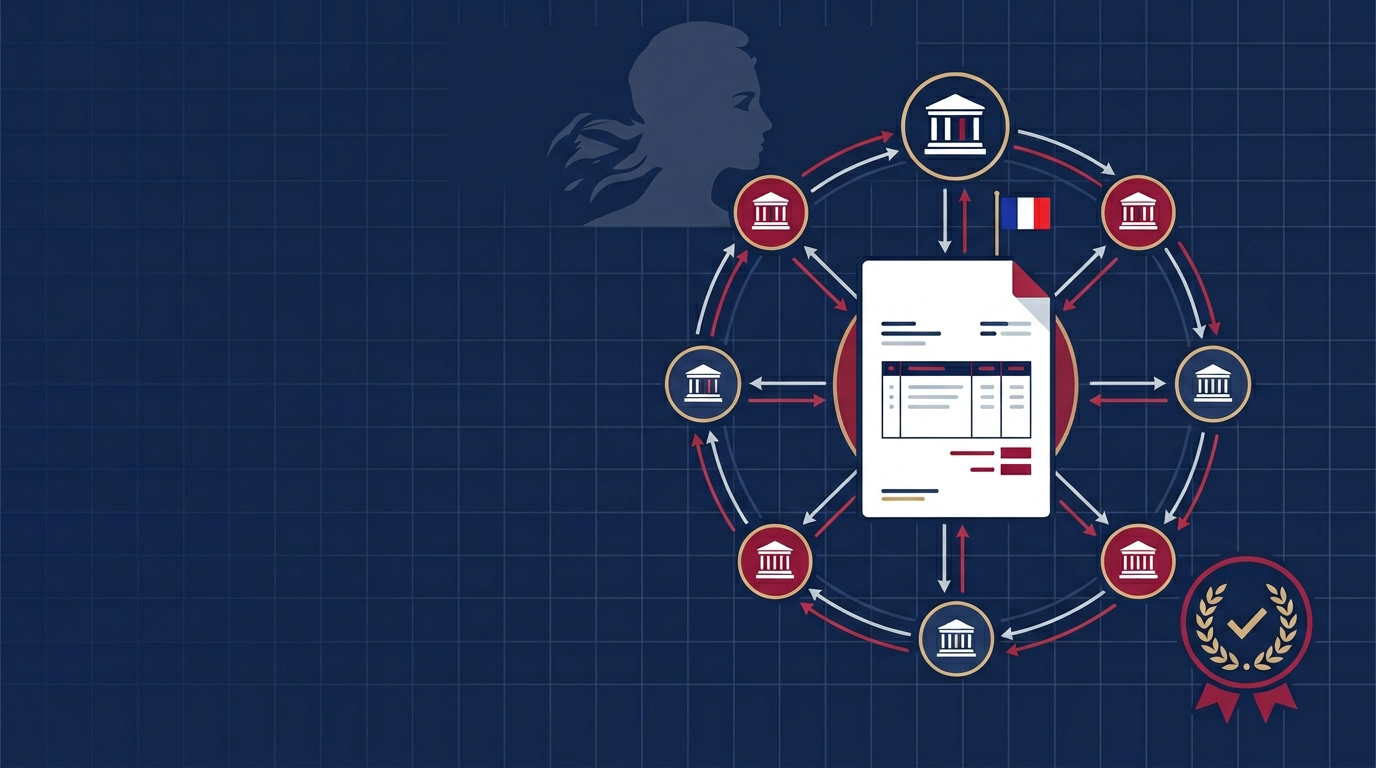
From September 1, 2026, every French company must be able to receive electronic invoices, and large and medium companies must issue them. Small and micro-businesses (most freelancers) must start issuing e-invoices on September 1, 2027. Invoices flow through a Plateforme Agréée and use Factur-X, UBL, or CII formats. Non-French freelancers will continue to send PDF invoices in the early phase, with French clients gradually requesting structured formats.
Read this calmly. The 2026 rollout is not asking auto-entrepreneurs to learn XML overnight. The phased timeline is:
- September 1, 2026. All French companies must be able to receive electronic invoices. Large and medium companies must issue them.
- September 1, 2027. Small and micro-businesses (TPE/PME) must issue electronic invoices.
Invoices will move through a Plateforme Agréée (PA), the new accredited private platforms that replace the earlier "PDP" naming. The accepted formats are Factur-X (a hybrid PDF + XML format that humans and machines can both read), UBL, and CII.
If you are a French freelancer, your invoicing tool will handle the format and the platform connection; you do not have to build any of this yourself. If you are based outside France and bill French clients, you can keep sending PDF invoices through 2026; expect French finance teams to start asking for Factur-X attachments later in 2027.
What are the most common French invoice mistakes?
Five errors come up again and again on French freelance invoices:
Five errors come up again and again on French freelance invoices:
- Missing the "EI" designation. If you are an Entrepreneur Individuel and your invoice does not show "EI" next to your name, it is technically non-compliant.
- Wrong franchise en base wording. Variations such as "TVA non applicable" alone or "Article 293B" without "du CGI" are rejected by some French accounting teams. Use the exact phrase: TVA non applicable, article 293 B du CGI.
- No €40 indemnité forfaitaire on B2B invoices. The €40 fixed late-payment indemnity is mandatory wording on every B2B invoice issued in France, even if you also state a percentage penalty rate.
- Confusing "date of issue" and "date of service". Both are mandatory and they are not always the same. The date of service is when the work was performed; the date of issue is when you sent the invoice.
- Reusing or skipping invoice numbers. The sequence must be unbroken and chronological. For the full rules, see our guide on sequential invoice numbering in the EU.
Quick answers
What is the exact phrase a French freelancer under franchise en base must put on the invoice?
The exact phrase required by Article 293 B of the Code général des impôts is "TVA non applicable, article 293 B du CGI". It must appear on every invoice issued under the franchise en base de TVA exemption, in French, near the totals.
The exact phrase required by Article 293 B of the Code général des impôts is "TVA non applicable, article 293 B du CGI". It must appear on every invoice issued under the franchise en base de TVA exemption, in French, near the totals. The invoice shows no TVA line and no TVA rate; the total equals the net amount.
Do I need a SIRET number to issue invoices as a freelancer in France?
Yes. Every French freelancer must include a 14-digit SIRET on every invoice.
Yes. Every French freelancer must include a 14-digit SIRET on every invoice. The SIRET is issued by INSEE when you register your activity. Invoices without a SIRET are not legally valid, and your French client cannot record them in their accounts. If your activity is registered as Entrepreneur Individuel, the designation "EI" must also appear next to your name.
When does the French e-invoicing mandate start, and does it affect non-French freelancers?
The French e-invoicing mandate starts on September 1, 2026, when all French companies must be able to receive electronic invoices and large and medium companies must issue them.
The French e-invoicing mandate starts on September 1, 2026, when all French companies must be able to receive electronic invoices and large and medium companies must issue them. Small and micro-businesses must start issuing on September 1, 2027. Non-French freelancers can continue to send PDF invoices in the early phase, with French clients gradually requesting Factur-X, UBL, or CII formats through a Plateforme Agréée.
How does autoliquidation work when a non-French freelancer invoices a French B2B client?
When a freelancer based outside France invoices a French VAT-registered business, autoliquidation applies under Article 283 of the Code général des impôts and Article 196 of the EU VAT Directive.
When a freelancer based outside France invoices a French VAT-registered business, autoliquidation applies under Article 283 of the Code général des impôts and Article 196 of the EU VAT Directive. You issue the invoice without TVA and include the wording "Autoliquidation - Article 283 du CGI" with both VAT numbers verified on VIES. The French client then accounts for TVA in its own return.
Does the Toubon Law require French freelance invoices to be entirely in French?
No.
No. The Loi Toubon of 1994 requires commercial documents to be available in French; it does not ban bilingual invoices. The cleanest solution is a bilingual template with French as the primary language. Mandatory wording such as "TVA non applicable, article 293 B du CGI" or "Autoliquidation - Article 283 du CGI" must appear in French exactly. Internationally recognised technical terms do not need to be translated.
The French invoice checklist to screenshot
The French invoice checklist to screenshot includes: Your legal name and address, with "EI" if you are an Entrepreneur Individuel. 14-digit SIRET (yours), and the client's SIRET or VAT number.
- Your legal name and address, with "EI" if you are an Entrepreneur Individuel.
- 14-digit SIRET (yours), and the client's SIRET or VAT number.
- Sequential, unbroken invoice number.
- Date of issue and date of service.
- Clear désignation with quantity and unit price.
- HT, TVA, and TTC amounts (or HT only if you are under franchise en base).
- Late-payment penalty rate plus the €40 indemnité forfaitaire on B2B invoices.
- "TVA non applicable, article 293 B du CGI" if exempt; "Autoliquidation - Article 283 du CGI" if cross-border B2B.
- Numéro de TVA intracommunautaire when applicable.
French invoicing rewards consistency. Once your template is right, every invoice after it is right. Invoicemonk applies the SIRET, the "EI" tag, sequential numbering, and the franchise en base / autoliquidation wording automatically, so you do not have to remember the exact phrase every time.
Create your first French-compliant invoice .
For the EU-wide rules that sit behind these French specifics, read our pillar on cross-border VAT and reverse charge for EU freelancers, plus our country guides on EU VAT invoice requirements, invoicing German clients, Dutch invoice requirements, sequential invoice numbering, and how to issue a credit note. External: VIES VAT validation and the European Commission eInvoicing France page.
Digital Marketing, SEO Specialist, Content Creator & Product Professional
Olayinka is a digital marketer, content creator, growth and SEO specialist with 10+ years helping businesses in Nigeria, the UK, the US, Australia, and Dubai achieve their goals online.