Invoicing Kenyan clients as a foreign freelancer (2026)
Your Kenyan client asked for a "KRA-compliant invoice." Maybe they even mentioned eTIMS. Now you are wondering whether you need to register with Kenya's Revenue Authority before you can get paid.
The short answer: almost certainly not. eTIMS, Kenya's mandatory electronic invoicing system, applies to businesses operating in Kenya. As a foreign freelancer without a Kenyan establishment or KRA PIN, you are not required to use it. But your invoice still needs to be right. Here is exactly what "KRA-compliant" means for a non-resident supplier, plus the reverse charge rules and the 20% withholding tax detail most guides skip.
What eTIMS is, and who it applies to
eTIMS (electronic Tax Invoice Management System) is Kenya's national platform for generating, validating, and submitting tax invoices in real time to the Kenya Revenue Authority (KRA). Since January 2024 it has been mandatory for all businesses operating in Kenya, whether VAT-registered or not.
eTIMS (electronic Tax Invoice Management System) is Kenya's national platform for generating, validating, and submitting tax invoices in real time to the Kenya Revenue Authority (KRA). Since January 2024 it has been mandatory for all businesses operating in Kenya, whether VAT-registered or not. Foreign freelancers without a Kenyan establishment or KRA PIN are out of scope.
Every invoice issued by a Kenyan business must pass through or be reported to eTIMS, and any expense not backed by a valid eTIMS invoice is non-deductible for Kenyan income tax purposes. The operative phrase is "businesses operating in Kenya." The mandate covers entities with a Kenya presence: sole traders, companies, and professionals registered in Kenya with a KRA PIN. It does not extend to foreign suppliers without a Kenyan establishment.
One important consequence: your Kenyan client needs an eTIMS invoice for purchases to be deductible as a business expense. The exemption under Kenya's Tax Procedures Act specifically covers "services by non-resident persons without a permanent establishment in Kenya," meaning your non-eTIMS invoice is still a valid supporting document for their records, even though it cannot be processed through eTIMS.
For a full guide to how eTIMS works for Kenyan businesses, see our eTIMS Kenya guide.
What your Kenyan client actually means by "KRA-compliant"
When a Kenyan client asks for a "KRA-compliant invoice," they are not asking you to use eTIMS. They are asking for an invoice that contains the fields their accountant needs to process the payment, record the expense, and handle their own withholding tax obligations.
When a Kenyan client asks for a "KRA-compliant invoice," they are not asking you to use eTIMS. They are asking for an invoice that contains the fields their accountant needs to process the payment, record the expense, and handle their own withholding tax obligations.
For a foreign supplier, "KRA-compliant" in practice means an invoice that includes:
- Your full legal name, business name, and address
- Your country of tax residence and tax identification number (whatever your country issues)
- The client's full legal name and address
- The client's KRA PIN, an 11-character alphanumeric identifier (for example, P051234567A) that all Kenyan businesses must have
- A sequential invoice number
- The date of issue and the date of service
- A clear description of services performed
- The net amount and currency
- A note explaining that no Kenyan VAT is charged and why (see Section 4)
That is what "KRA-compliant" means for you. It is about the fields on the invoice, not the platform it was issued from.
Do you need to register for VAT in Kenya?
For most foreign freelancers billing Kenyan business clients, no. VAT registration in Kenya is required for businesses with annual taxable turnover exceeding KES 5 million (approximately USD 38,000) from Kenyan sources.
For most foreign freelancers billing Kenyan business clients, no. VAT registration in Kenya is required for businesses with annual taxable turnover exceeding KES 5 million (approximately USD 38,000) from Kenyan sources. As a non-resident foreign freelancer without a permanent establishment in Kenya, you are generally not within the scope of Kenya's VAT Act for your outbound services.
There is a nuance for digital services: Kenya requires non-resident suppliers of digital services to Kenyan consumers to register for VAT regardless of turnover. If you provide digital products (software subscriptions, streaming, online courses, digital downloads) directly to Kenyan individual consumers, VAT registration may apply. If you are billing a Kenyan business client for professional services (development, design, consulting, marketing), this rule does not apply.
The distinction matters: B2B professional services from a foreign supplier to a Kenyan business trigger the reverse charge mechanism (next section). B2C digital services to Kenyan individuals trigger a different set of rules entirely. When in doubt, consult a Kenyan tax advisor; KRA's guidance on non-resident suppliers is available at kra.go.ke.
Reverse charge in Kenya: what it means for your invoice
When a Kenyan business receives taxable services from a non-resident supplier without a Kenyan permanent establishment, Kenya's VAT Act applies the reverse charge mechanism. The Kenyan business, not the foreign supplier, accounts for and pays the VAT to KRA.
When a Kenyan business receives taxable services from a non-resident supplier without a Kenyan permanent establishment, Kenya's VAT Act applies the reverse charge mechanism. The Kenyan business, not the foreign supplier, accounts for and pays the VAT to KRA. This is the same logic as the EU's reverse charge, but governed by Kenya's domestic VAT legislation rather than the EU VAT Directive.
What this means for your invoice:
- You do not charge Kenyan VAT (currently 16% standard rate)
- You invoice at the net amount only
- You include a note on the invoice explaining the VAT treatment
Suggested wording for your invoice:
"This invoice is issued by a non-resident supplier without a permanent establishment in Kenya. No Kenyan VAT is charged. VAT accounting is the responsibility of the recipient under the reverse charge provisions of Kenya's VAT Act, Cap 476."
Your invoice must also include your client's KRA PIN; their accountant needs it to process the reverse charge in their VAT return.
Withholding tax: the detail most guides skip
Kenya also applies withholding tax (WHT) to certain payments to non-resident suppliers, including professional and management fees. The standard WHT rate for non-resident service providers is 20% of the gross payment. Your Kenyan client deducts this 20% at source: they pay you the net amount and remit the 20% to KRA directly.
What this means for your invoice: you invoice the full agreed amount. Your client deducts 20% WHT and pays you the remainder. They should issue you a withholding tax certificate (available through iTax) as proof of deduction; keep this for your own tax records in your home country.
If Kenya has a Double Taxation Agreement (DTA) with your country of residence, the WHT rate may be reduced. Kenya has DTAs with several countries including Germany, the UK, India, and Canada. Check the current treaty rate with a Kenyan tax advisor or on the KRA website before your first invoice.
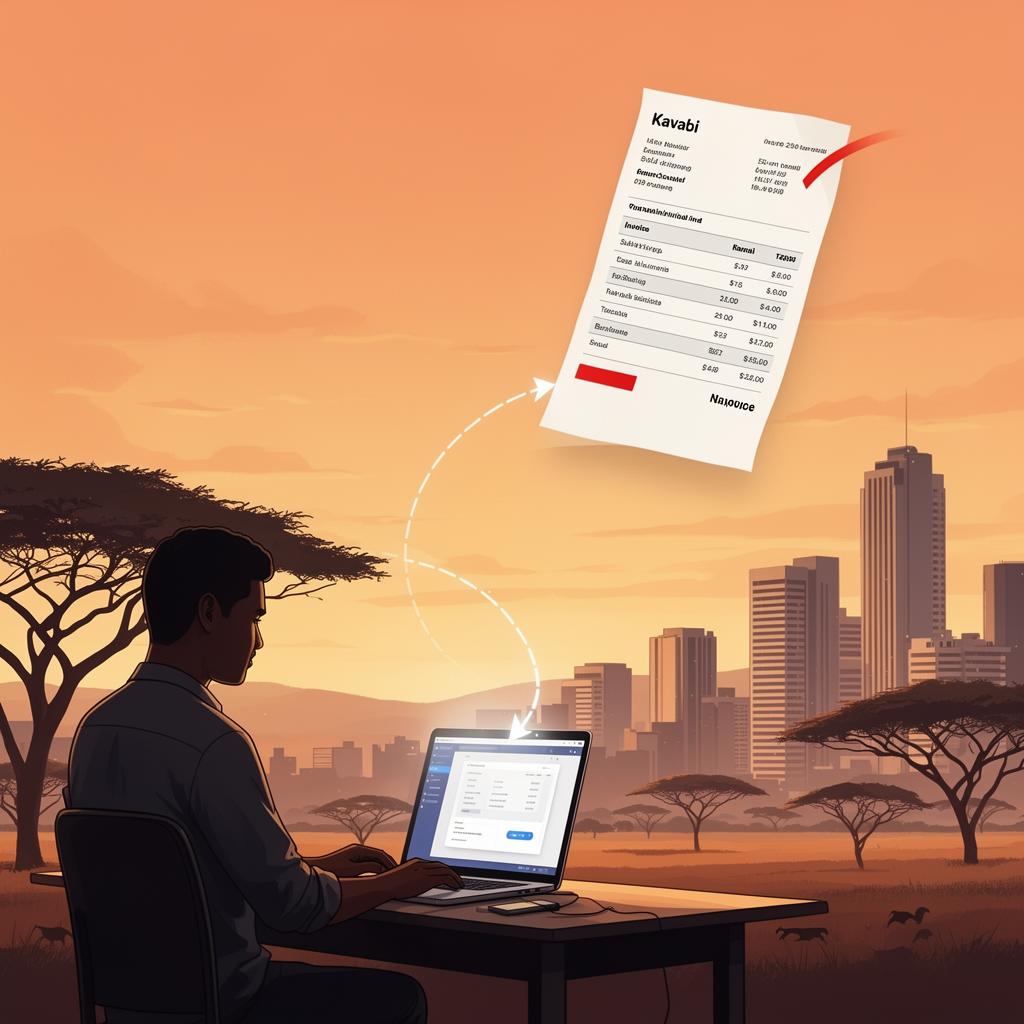
Here is what a complete, KRA-compliant invoice from a foreign freelancer looks like.
The complete invoice checklist for foreign freelancers billing Kenyan clients
Every invoice to a Kenyan business client must include:
Every invoice to a Kenyan business client must include:
- Your full legal name and business name (personal legal name for sole traders)
- Your business address and country of residence; make your non-Kenyan status clear
- Your home country tax identification number (VAT number, tax file number, or equivalent)
- Your client's full legal name and address
- Your client's KRA PIN: 11-character alphanumeric (for example, P051234567A). Always ask for it before issuing the first invoice
- A unique sequential invoice number
- Date of issue and date of service
- A specific description of services. Vague descriptions like "consulting" are not sufficient. "Brand strategy and content framework, delivered June 2026" is correct
- Net amount and currency. Specify USD, EUR, GBP, or whatever currency was agreed. If quoting in a foreign currency, your client may convert to KES for their VAT return
- No Kenyan VAT line: you are not charging it
- The reverse charge and non-resident note (the wording from Section 4)
- Your bank details or payment instructions: IBAN for SEPA, SWIFT/BIC for international wire
Note on currency: there is no legal requirement to denominate your invoice in KES as a foreign supplier. Invoice in your preferred currency. Your client's accountant handles the conversion for their records.
If you are a Kenyan freelancer billing international clients
If you are a Kenyan freelancer using eTIMS for domestic clients but billing clients outside Kenya, those invoices fall outside eTIMS scope only in terms of VAT charged: exports of services are zero-rated for VAT purposes in Kenya. You charge 0% VAT, not 16%.
If you are a Kenyan freelancer using eTIMS for domestic clients but billing clients outside Kenya, those invoices fall outside eTIMS scope only in terms of VAT charged: exports of services are zero-rated for VAT purposes in Kenya. You charge 0% VAT, not 16%. Your eTIMS invoice should reflect the 0% rate with an export notation.
You are still required to issue the invoice through eTIMS even for export transactions; the system records the zero-rated supply for your VAT return. What changes is the VAT rate, not the platform.
Your foreign client does not access or interact with eTIMS. They receive a standard invoice from you (a PDF export from your eTIMS-integrated software or an Invoicemonk invoice) and handle their own VAT in their country. For a full breakdown of eTIMS registration and the four access channels, see our eTIMS Kenya guide and the related KRA invoice requirements overview.
The most common mistakes foreign freelancers make when billing Kenyan clients
The most common mistakes foreign freelancers make when billing Kenyan clients includes: Assuming eTIMS applies to them. eTIMS is mandatory for businesses operating in Kenya.
- Assuming eTIMS applies to them. eTIMS is mandatory for businesses operating in Kenya. Foreign freelancers without a Kenyan establishment or KRA PIN are not within scope. Your invoice does not need to be issued through eTIMS.
- Not including the client's KRA PIN. The KRA PIN is essential for the client's accountant to process the reverse charge and withholding tax in their iTax records. Always ask for it before issuing your first invoice.
- Not accounting for withholding tax in your pricing. The 20% non-resident WHT is deducted by the client from your payment. If you invoice KES 100,000, you receive KES 80,000. Factor this into your pricing or discuss it explicitly with the client before agreeing a rate.
- Issuing the invoice in KES without knowing the exchange rate. If you agree to bill in a currency other than your own, make sure the exchange rate calculation is clear and agreed in advance. Currency fluctuations between invoice date and payment date can significantly affect what you actually receive.
- Writing "VAT: 0%" without an explanation. Zero-rated and reverse charge are different treatments. Include the non-resident reverse charge wording from Section 4 so your client's accountant knows exactly how to process it.
Quick-reference checklist
Foreign freelancer billing a Kenyan business client checklist:
Foreign freelancer billing a Kenyan business client checklist:
- Your legal name, address, country of residence, home country tax ID
- Client's name, address, and KRA PIN (11-character alphanumeric)
- Sequential invoice number
- Date of issue and date of service
- Specific service description
- Net amount and currency: no Kenyan VAT
- Non-resident reverse charge note: "No Kenyan VAT charged. Reverse charge applies under Kenya's VAT Act, Cap 476."
- Bank details for payment
- Note: 20% withholding tax will be deducted by client at source
Create your first Kenyan-compliant invoice . Invoicemonk generates all required fields, including the reverse charge notation and the KRA PIN field.
For how eTIMS works for Kenyan businesses, read our full eTIMS Kenya guide and the KRA invoice requirements overview. Invoicing across borders elsewhere? See the pillar guides on EU VAT invoice requirements, cross-border VAT and reverse charge, and sequential invoice numbering.
Digital Marketing, SEO Specialist, Content Creator & Product Professional
Olayinka is a digital marketer, content creator, growth and SEO specialist with 10+ years helping businesses in Nigeria, the UK, the US, Australia, and Dubai achieve their goals online.