Quarterly Tax Payment Guide for Small Business Owners
Tax & Compliance Series
This guide is part of a comprehensive series. Explore all 202 topics:
If you're self-employed or run a small business, you likely need to make quarterly estimated tax payments. Unlike employees who have taxes withheld from each paycheck, business owners must calculate and pay taxes throughout the year.
Failing to make quarterly payments can result in underpayment penalties of 5–10% of the amount owed, even if you pay everything at year-end. This guide covers everything you need to know.
Who Needs to Pay Quarterly Taxes?
You generally need to make quarterly payments if you expect to owe $1,000 or more in taxes for the year.
You generally need to make quarterly payments if you expect to owe $1,000 or more in taxes for the year. This typically includes:
- Freelancers and independent contractors
- Sole proprietors
- Partners in partnerships
- S corporation shareholders
- Landlords with rental income
- Anyone with significant investment income
Quarterly Tax Deadlines
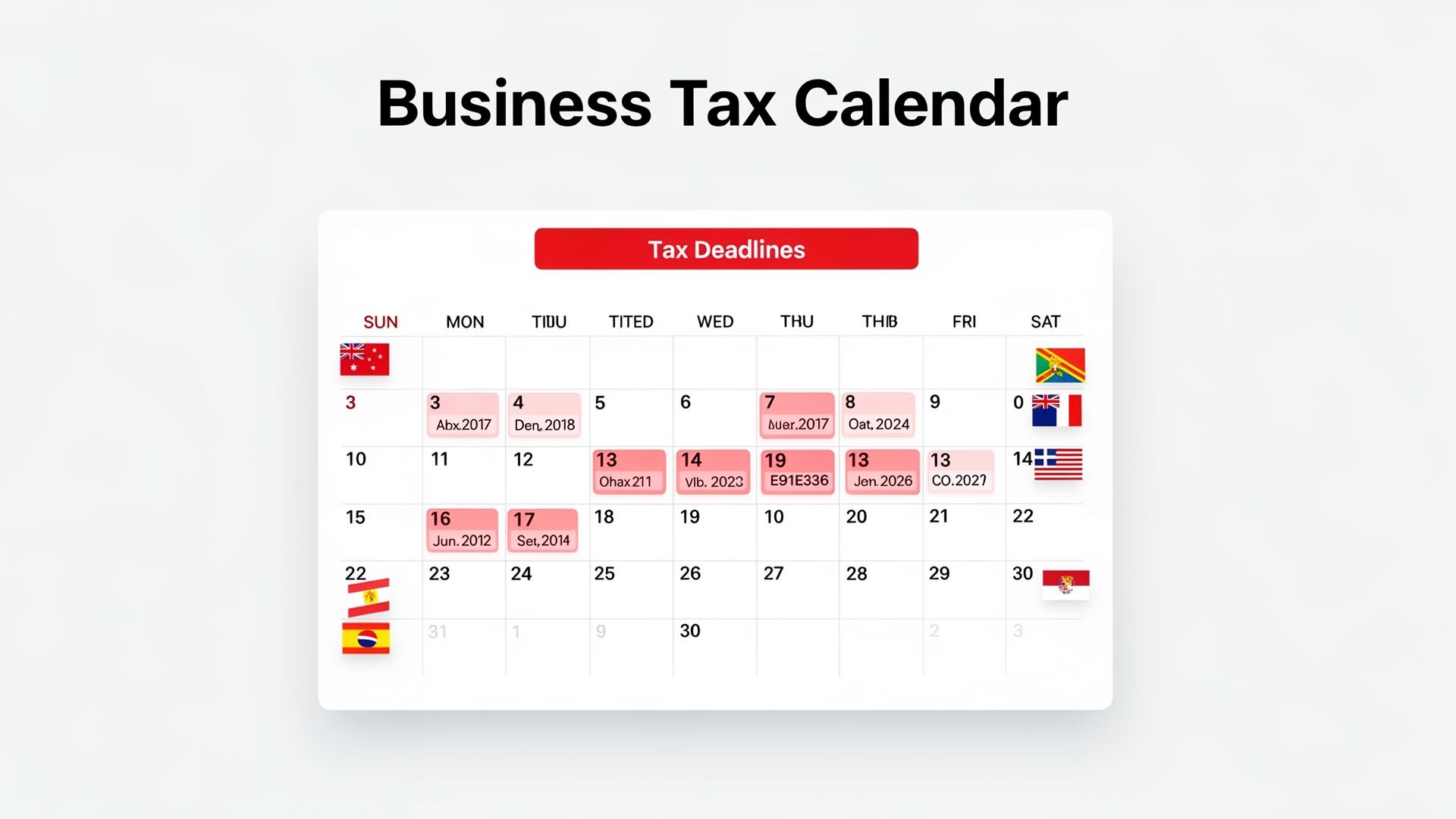
Note that deadlines vary by country. See our tax calendar by country for specific dates.
Note that deadlines vary by country. See our tax calendar by country for specific dates.
United States (IRS)
| Quarter | Period Covered | Due Date |
|---|---|---|
| Q1 | Jan 1 – Mar 31 | April 15 |
| Q2 | Apr 1 – May 31 | June 15 |
| Q3 | Jun 1 – Aug 31 | September 15 |
| Q4 | Sep 1 – Dec 31 | January 15 (next year) |
For detailed US requirements, see our IRS compliance guide.
United Kingdom (HMRC)
UK self-assessment uses two payment-on-account instalments (January 31 and July 31) rather than quarterly payments.
Nigeria (FIRS)
Companies pay provisional tax in instalments. See our FIRS compliance guide for specifics.
How to Calculate Quarterly Payments
Estimate annual income: Project your total business income for the year Subtract deductions: Remove eligible business expenses and tax deductions
- Estimate annual income: Project your total business income for the year
- Subtract deductions: Remove eligible business expenses and tax deductions
- Calculate tax liability: Apply your tax bracket rates to taxable income
- Add self-employment tax: Include social security/Medicare (US) or National Insurance (UK)
- Divide by 4: Each quarterly payment is roughly 25% of your annual tax bill
The Safe Harbour Rule (US)
To avoid underpayment penalties, pay either:
- 100% of last year's tax liability (divided into 4 payments), OR
- 90% of the current year's expected liability
If your adjusted gross income exceeds $150,000, the safe harbour is 110% of last year's tax.
Payment Methods
Payment Methods includes: Online: IRS Direct Pay, HMRC online, FIRS e-tax platform Bank transfer: EFTPS (US), bank transfer (UK)
- Online: IRS Direct Pay, HMRC online, FIRS e-tax platform
- Bank transfer: EFTPS (US), bank transfer (UK)
- Card payment: Available in most countries (processing fees may apply)
- Mail: Payment voucher with cheque (slowest option)
Common Quarterly Tax Mistakes
Common Quarterly Tax Mistakes includes: Not paying at all: "I'll sort it at year-end" leads to penalties Underestimating income: Especially in growth years—adjust estimates quarterly
- Not paying at all: "I'll sort it at year-end" leads to penalties
- Underestimating income: Especially in growth years—adjust estimates quarterly
- Forgetting self-employment tax: This adds 15.3% (US) on top of income tax
- Missing deadlines: Even one day late can trigger penalties
- Not adjusting: If income changes significantly, recalculate mid-year
Staying Organised
Proper bookkeeping makes quarterly taxes manageable:
Proper bookkeeping makes quarterly taxes manageable:
- Track income and expenses monthly using accounting software
- Set aside 25–30% of every payment received for taxes
- Keep receipts for all deductible expenses
- Review financial reports quarterly before making payments
- Use a dedicated tax savings account
Typical Filing Deadlines by Country
Deadlines vary widely — from quarterly estimated payments in the US to annual self-assessment in the UK.
| Country | Main filing type | Typical deadline | Frequency |
|---|---|---|---|
| United States | Estimated tax payments | Apr 15 / Jun 15 / Sep 15 / Jan 15 | Quarterly |
| United Kingdom | Self-assessment | January 31 | Annual (with payments on account) |
| Canada | Personal/business tax return | April 30 (June 15 for self-employed) | Annual |
| Australia | Business Activity Statement (BAS) | 28th of month after quarter end | Quarterly |
| Nigeria | Company income tax | 6 months after financial year end | Annual |
These are general guidelines only. Always confirm exact dates with your local tax authority, as rules change and vary by business structure.
Frequently Asked Questions
What happens if I miss a tax filing deadline?
Penalties vary by country but typically include a fixed fine plus interest on unpaid tax.
In the US, the failure-to-file penalty is 5 percent per month (up to 25 percent). In the UK, HMRC charges an immediate fixed penalty plus daily penalties after 3 months. In Nigeria, FIRS charges penalties plus interest. Filing late is always worse than paying late, so file on time even if you cannot pay the full amount.
Do tax deadlines change if they fall on a weekend or holiday?
Yes, in most countries the deadline typically shifts to the next business day.
However, it is best practice to plan for the original date to avoid last-minute surprises, and to confirm with your specific tax authority.
How do I keep track of multiple tax deadlines across countries?
Use a shared calendar with reminders set 2-4 weeks before each deadline, or invoicing software that tracks tax dates automatically.
For businesses operating in more than one country, a dedicated tax calendar tool or accountant is usually worth the cost, since penalty exposure multiplies with each jurisdiction.
Related Resources
- Complete Tax Compliance Guide
- Small Business Tax Deductions
- Tax Calendar by Country
- Tax Audit Preparation
More in this series (202 articles)
From this series
Stay audit-ready and compliant with tax regulations across different regions.
Related Topics
Digital Marketing, SEO Specialist, Content Creator & Product Professional
Olayinka is a digital marketer, content creator, growth and SEO specialist with 10+ years helping businesses in Nigeria, the UK, the US, Australia, and Dubai achieve their goals online.