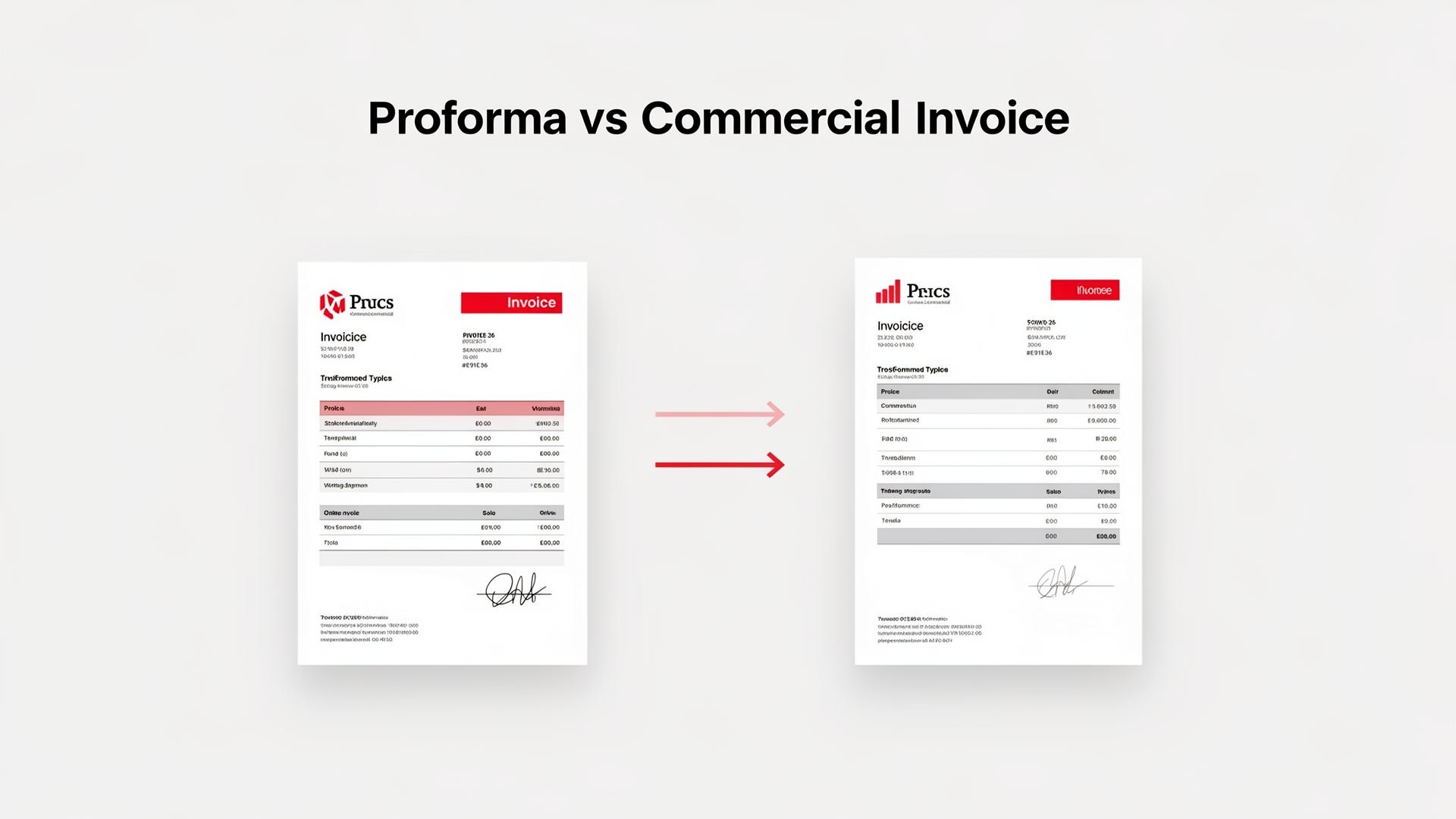
Proforma Invoice vs Commercial Invoice: Key Differences Explained
Invoicing Mastery Series
This guide is part of a comprehensive series. Explore all 33 topics:
If you deal with international clients or trade goods across borders, you've likely encountered both proforma and commercial invoices. While they may look similar, they serve fundamentally different purposes—and using the wrong one can cause customs delays, legal issues, and payment confusion.
This guide breaks down the key differences so you always use the right document at the right time.
What Is a Proforma Invoice?
A proforma invoice is a preliminary document sent to a buyer before goods are delivered or services are completed. Think of it as a detailed quote or "good faith" estimate.
A proforma invoice is a preliminary document sent to a buyer before goods are delivered or services are completed. Think of it as a detailed quote or "good faith" estimate. It outlines what will be provided, at what cost, and under what terms.
Key characteristics:
- Issued before a transaction is completed
- Not a demand for payment
- Not recorded as accounts receivable
- Used for customs pre-clearance and import licensing
- Can be revised before the final invoice
What Is a Commercial Invoice?
A commercial invoice is the official, legally binding document that requests payment for goods or services delivered. It's the "real" invoice—the one that appears in your accounting records and serves as proof of the transaction.
A commercial invoice is the official, legally binding document that requests payment for goods or services delivered. It's the "real" invoice—the one that appears in your accounting records and serves as proof of the transaction.
Key characteristics:
- Issued after goods are shipped or services delivered
- A formal demand for payment
- Recorded in accounts receivable and payable
- Required for customs clearance at destination
- Legally binding—represents a completed transaction
Side-by-Side Comparison
Side-by-Side Comparison — Purpose: Estimate / quotation — Payment request.
| Feature | Proforma Invoice | Commercial Invoice |
|---|---|---|
| Purpose | Estimate / quotation | Payment request |
| Timing | Before delivery | After delivery |
| Legal status | Not legally binding | Legally binding |
| Payment obligation | None | Yes |
| Accounting entry | Not recorded | Recorded as revenue |
| Customs use | Pre-clearance / licensing | Final clearance |
| Can be modified | Yes, freely | Only via credit notes |
When to Use a Proforma Invoice
International quotes: When a foreign buyer needs a formal document for import licenses or letters of credit Customs pre-clearance: Buyers may need proforma invoices to arrange import permits before shipment
- International quotes: When a foreign buyer needs a formal document for import licenses or letters of credit
- Customs pre-clearance: Buyers may need proforma invoices to arrange import permits before shipment
- Price negotiations: As a formal starting point that can be revised
- New client relationships: To set expectations before work begins
- Grant or funding applications: When clients need cost documentation for approval
When to Use a Commercial Invoice
After delivery: Once goods are shipped or services completed Customs clearance: Required for goods to clear customs at the destination country
- After delivery: Once goods are shipped or services completed
- Customs clearance: Required for goods to clear customs at the destination country
- Payment collection: As the formal request for payment
- Tax compliance: For proper revenue recording and tax reporting
- Accounting records: To maintain accurate financial books
Common Mistakes to Avoid
For more on avoiding invoice errors, read our guide on invoice mistakes that cost you money.
- Using a proforma as a tax document: Proforma invoices should never be used for tax deductions or accounting records
- Mismatching amounts: The commercial invoice amount should match the proforma unless changes were agreed upon
- Missing customs information: Commercial invoices for international trade must include HS codes, country of origin, and Incoterms
- Not converting to commercial: Every proforma should eventually result in either a commercial invoice or cancellation
For more on avoiding invoice errors, read our guide on invoice mistakes that cost you money.
International Trade Requirements
When trading internationally, commercial invoices typically must include:
When trading internationally, commercial invoices typically must include:
- Harmonized System (HS) tariff codes
- Country of origin for each item
- Incoterms (e.g., FOB, CIF, DDP)
- Currency and exchange rate (if applicable)
- Detailed product descriptions with weights and quantities
Different countries have specific requirements. Check our compliance guides for Nigeria, UK, US, Canada, and Australia.
How Invoicemonk Helps
Invoicemonk supports both proforma and commercial invoices, making it easy to:
Invoicemonk supports both proforma and commercial invoices, making it easy to:
- Create professional proforma invoices with one click
- Convert proforma to commercial invoices automatically
- Ensure all required fields are included for compliance
- Track the lifecycle from quote to payment
Related Resources
More in this series (33 articles)
From this series
Master the art of professional invoicing to get paid faster and look more professional.
Related Topics
Digital Marketing, SEO Specialist, Content Creator & Product Professional
Olayinka is a digital marketer, content creator, growth and SEO specialist with 10+ years helping businesses in Nigeria, the UK, the US, Australia, and Dubai achieve their goals online.