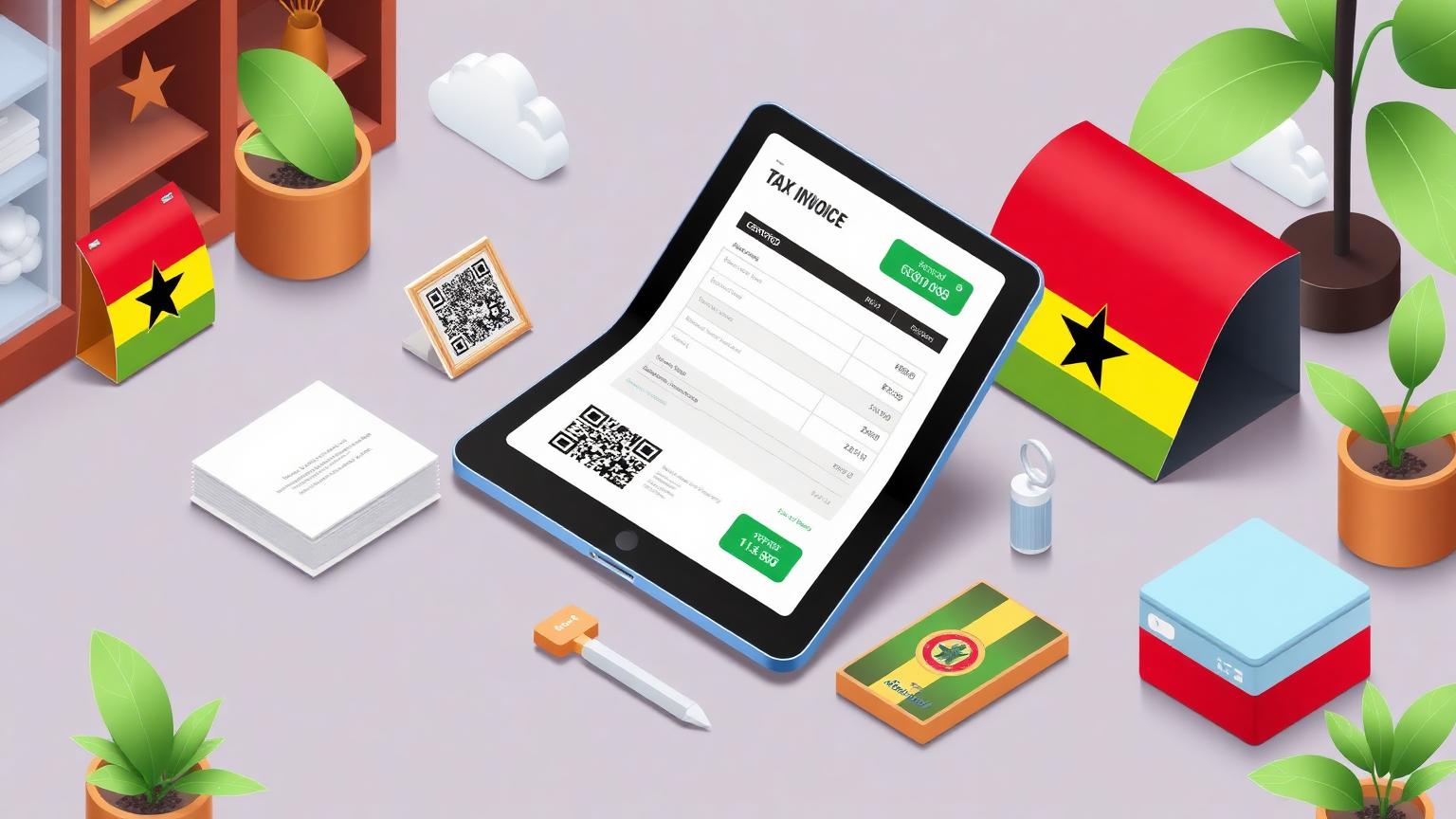
How to Comply with GRA E-VAT in Ghana: Onboard, Connect, and Issue Your First Certified Invoice (2026)
Global E-Invoicing Platform Series
This guide is part of a comprehensive series. Explore all 36 topics:
To comply with GRA E-VAT in Ghana in 2026, a VAT-registered business must hold an active Taxpayer Identification Number with VAT registration, enrol the entity on the GRA Taxpayers Portal, integrate its invoicing platform with the GRA E-VAT API using GRA-issued credentials, build the certified-invoice payload to the GRA schema (now updated for the unified 15% VAT rate under Act 1151 and the repeal of the COVID-19 health levy), transmit and receive the GRA Invoice Reference Number (IRN) plus QR, and present both on every buyer-facing invoice — without an IRN the invoice is not legally valid for input VAT recovery.
At a glance
- Authority: Ghana Revenue Authority (GRA).
- Mandate: Electronic VAT Invoicing System (E-VAT) under VAT Act 2025 (Act 1151), effective 1 January 2026.
- Artefact: Certified invoice with GRA-issued Invoice Reference Number (IRN) and verification QR.
- Transport: GRA E-VAT API with credentials bound to the taxpayer TIN.
- Tax stack (from 1 Jan 2026): Unified 15% VAT (flat-rate scheme abolished), NHIL 2.5%, GETFL 2.5%, COVID-19 levy repealed.
- Threshold: Compulsory VAT registration at GHS 750,000 annual turnover (raised by Act 1151).
- Last reviewed: 20 November 2026 against the GRA VAT Administrative Guidelines GRA/AG/25/002 and EY Reference Guide to Act 1151.
Where E-VAT sits in the global e-invoicing landscape
GRA E-VAT is a clearance regime — every in-scope invoice is transmitted to GRA, validated, stamped with an Invoice Reference Number, and only then is legally valid. That puts it in the same architectural family as ZATCA Phase 2 in Saudi Arabia, FIRS MBS in Nigeria, KRA eTIMS in Kenya, and MyInvois in Malaysia.
GRA E-VAT is a clearance regime — every in-scope invoice is transmitted to GRA, validated, stamped with an Invoice Reference Number, and only then is legally valid. That puts it in the same architectural family as ZATCA Phase 2 in Saudi Arabia, FIRS MBS in Nigeria, KRA eTIMS in Kenya, and MyInvois in Malaysia. For the broader split, see clearance vs reporting models in e-invoicing.
What you need before you start
A valid GRA Taxpayer Identification Number (TIN) with active VAT registration (compulsory at GHS 750,000 annual turnover under Act 1151). An invoicing platform integrated with the GRA E-VAT API and updated to the unified 15% rate schema.
- A valid GRA Taxpayer Identification Number (TIN) with active VAT registration (compulsory at GHS 750,000 annual turnover under Act 1151).
- An invoicing platform integrated with the GRA E-VAT API and updated to the unified 15% rate schema.
- GRA-issued credentials for the certified invoicing flow, bound to your TIN.
- An updated chart-of-accounts that separately tracks output VAT, NHIL, GETFL, and (for transitional invoices) the repealed COVID levy.
Step 1 — Register on the GRA Taxpayers Portal
Log in to taxpayersportal. gra.
Log in to taxpayersportal.gra.gov.gh with your TIN, enrol the entity for E-VAT, and complete the operator profile. GRA confirms enrolment and issues the API credentials bound to your TIN — usually within five working days.
What if my business is below the new GHS 750,000 threshold?
Voluntary VAT registration remains available. If you are not VAT-registered, you are out of scope for the certified invoice mandate.
Voluntary VAT registration remains available. If you are not VAT-registered, you are out of scope for the certified invoice mandate. If you opt in voluntarily (often to recover input VAT on equipment), you accept the full E-VAT clearance obligation alongside the registration.
Step 2 — Map your invoice to the GRA schema
The GRA E-VAT payload requires:
The GRA E-VAT payload requires:
- Seller TIN and buyer TIN (buyer optional for B2C below a threshold).
- Line items with descriptions and HS codes where applicable.
- Unified VAT (15% standard rate) per Act 1151 — the flat-rate scheme for retailers and the 3% transitional rate are abolished.
- NHIL 2.5% and GETFL 2.5% — both retained as separate levy lines.
- Currency and FX rate where the invoice is non-GHS.
- Document type code: invoice / credit note / debit note.
Do I still apply the COVID-19 levy?
No. The 1% COVID-19 Health Recovery Levy is repealed by Act 1151 with effect from 1 January 2026.
No. The 1% COVID-19 Health Recovery Levy is repealed by Act 1151 with effect from 1 January 2026. Any invoice dated on or after that date must omit it. Invoices for periods before 1 January 2026 continue to carry the levy and must reconcile separately.
Step 3 — Transmit to the GRA E-VAT API
Step 3 — Transmit to the GRA E-VAT API includes: The platform builds the GRA payload from the underlying invoice. The payload is signed with the taxpayer credentials and submitted to the GRA E-VAT endpoint.
- The platform builds the GRA payload from the underlying invoice.
- The payload is signed with the taxpayer credentials and submitted to the GRA E-VAT endpoint.
- GRA validates the schema, the TINs, and the VAT/levy calculation.
- GRA returns the Invoice Reference Number (IRN) plus a verification QR that resolves to the public GRA verification page.
- The platform binds the IRN and QR to the buyer-facing PDF.
Step 4 — Present the IRN and QR on every invoice
Every certified invoice must display the GRA IRN and QR. The QR resolves to GRA's verification page that confirms the invoice's status.
Every certified invoice must display the GRA IRN and QR. The QR resolves to GRA's verification page that confirms the invoice's status. Without the IRN, the invoice is not legally valid and the buyer cannot recover input VAT. See what is an IRN, across jurisdictions and QR codes on tax invoices explained.
Step 5 — Reconcile in your VAT return
Because GRA already holds the certified data, your monthly VAT return reconciles against the IRNs issued during the period. Discrepancies between platform-issued IRNs and the GRA registry are the first thing GRA audits — Invoicemonk reconciles automatically and flags drift before the filing deadline.
Because GRA already holds the certified data, your monthly VAT return reconciles against the IRNs issued during the period. Discrepancies between platform-issued IRNs and the GRA registry are the first thing GRA audits — Invoicemonk reconciles automatically and flags drift before the filing deadline.
What changed under VAT Act 2025 (Act 1151)
Per the GRA VAT Administrative Guidelines GRA/AG/25/002 (31 December 2025) and the EY Reference Guide to Act 1151 (January 2026), the key changes effective 1 January 2026:
Per the GRA VAT Administrative Guidelines GRA/AG/25/002 (31 December 2025) and the EY Reference Guide to Act 1151 (January 2026), the key changes effective 1 January 2026:
- Unified VAT rate at 15%, flat-rate scheme abolished — retailers and small businesses now apply the standard 15%.
- COVID-19 1% levy repealed.
- VAT registration threshold raised to GHS 750,000 annual turnover.
- NHIL 2.5% and GETFL 2.5% retained as separate levy lines, computed in a prescribed sequence on the VAT-inclusive base.
- Expanded scope: exploration of natural resources and export of traditional products now expressly within VAT scope.
Pre-go-live compliance checklist
Pre-go-live compliance checklist includes: ☐ TIN active with VAT registration on taxpayersportal. gra.
- ☐ TIN active with VAT registration on taxpayersportal.gra.gov.gh.
- ☐ Invoicing platform updated to Act 1151 — unified 15% rate, no COVID levy.
- ☐ GRA E-VAT API credentials installed; smoke-test invoice cleared successfully.
- ☐ Chart-of-accounts separates output VAT, NHIL, GETFL.
- ☐ Buyer PDF template renders the GRA IRN and QR prominently.
- ☐ Monthly reconciliation between platform IRNs and GRA registry scheduled.
- ☐ Transitional handling for invoices dated before 1 January 2026 (COVID levy + flat-rate scheme) documented.
Authority sources
- GRA — E-VAT service portal
- GRA — VAT tax type guidance
- GRA — VAT Administrative Guidelines GRA/AG/25/002 (31 Dec 2025)
- EY Global Tax News — Ghana indirect tax laws effective 1 January 2026
- KPMG — Ghana VAT measures from 2026 budget enacted
- GRA — Notice to all VAT registered taxpayers
TL;DR
Enrol your TIN on the GRA Taxpayers Portal, install E-VAT API credentials, build the payload to the Act 1151 schema (unified 15% VAT + NHIL 2. 5% + GETFL 2.
Enrol your TIN on the GRA Taxpayers Portal, install E-VAT API credentials, build the payload to the Act 1151 schema (unified 15% VAT + NHIL 2.5% + GETFL 2.5%, no COVID levy), transmit to GRA, present the IRN and QR on every buyer PDF, and reconcile your monthly VAT return against the GRA registry.
Related reading
Related reading includes: GRA E-VAT — how Invoicemonk implements it for Ghana GRA E-VAT Ghana explained: scope, thresholds, VAT and levies
- GRA E-VAT — how Invoicemonk implements it for Ghana
- GRA E-VAT Ghana explained: scope, thresholds, VAT and levies
- What is an IRN — across jurisdictions
- Clearance vs reporting models
Ready to issue your first certified invoice today? See how Invoicemonk handles GRA E-VAT end to end.
More in this series (36 articles)
From this series
Mandate-compliant e-invoicing in 17 jurisdictions, with the local artefact (CSID, IRN, UUID, QR, digital signature) issued automatically.
Digital Marketing, SEO Specialist, Content Creator & Product Professional
Olayinka is a digital marketer, content creator, growth and SEO specialist with 10+ years helping businesses in Nigeria, the UK, the US, Australia, and Dubai achieve their goals online.