Accounting 101 for Small Business Owners
Business Finances Series
This guide is part of a comprehensive series. Explore all 16 topics:
According to a U.S. Bank study, 82% of small businesses fail because of cash-flow mismanagement. The root cause is almost always the same: the owner never learned the accounting basics that underpin every financial decision. You don't need a CPA licence to run your books — you need to understand how money flows through your business and what the numbers mean.
This guide covers the core accounting concepts every small-business owner should know, whether you run a one-person freelance studio or a growing team of twenty.
Why Accounting Matters for Small Business Owners
Accounting is the language of business. It translates daily transactions — sales, purchases, payroll — into structured information you can act on.
Accounting is the language of business. It translates daily transactions — sales, purchases, payroll — into structured information you can act on. Without it, you're flying blind: you might feel profitable while quietly running out of cash, or conversely, panic about expenses that are perfectly normal for your growth stage.
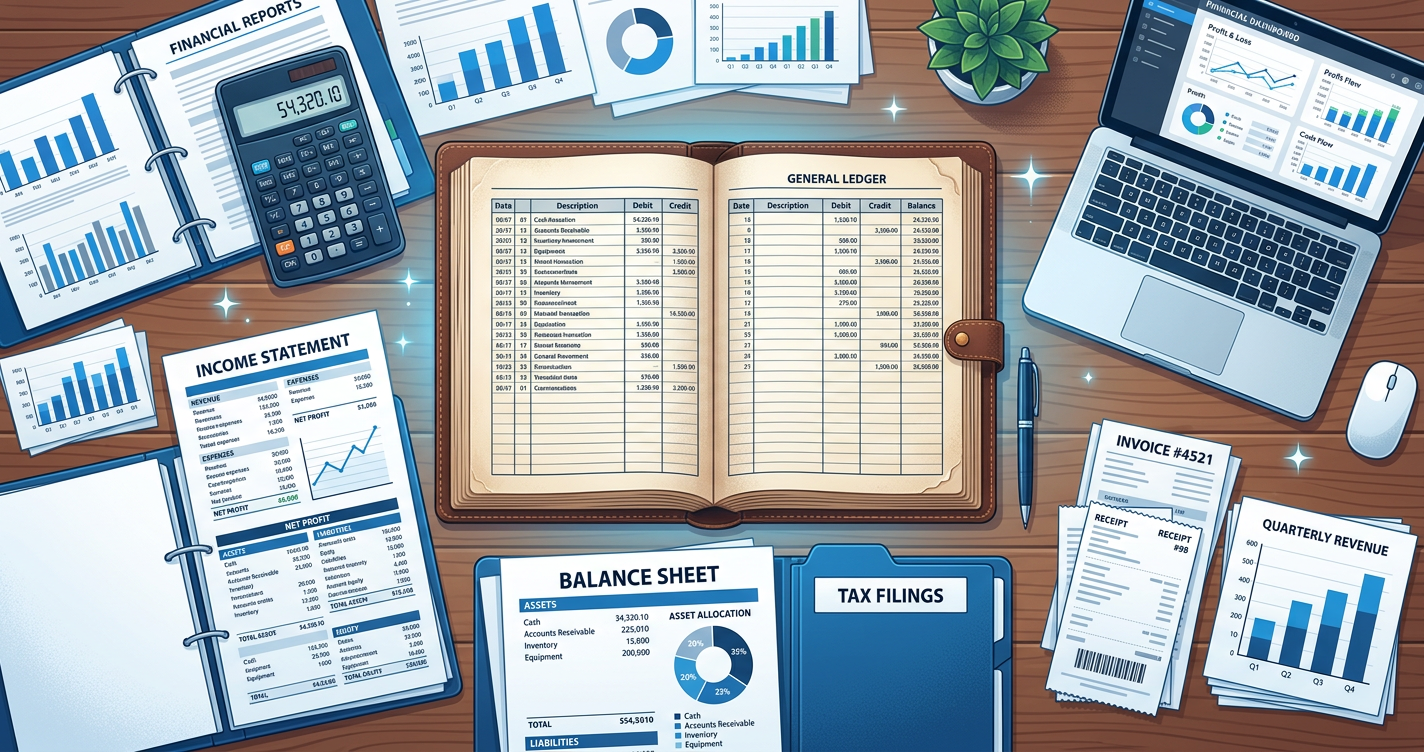
Good accounting helps you answer three questions at any time: How much money do I have? How much do I owe? Am I actually making a profit? Those answers live in three foundational financial statements: the income statement (also called a profit-and-loss statement), the balance sheet, and the cash-flow statement.
Beyond internal clarity, proper accounting is a legal requirement. Tax authorities like the IRS, HMRC, and FIRS expect you to maintain accurate records. Investors and lenders won't consider funding you without clean books. And if you ever sell the business, organised finances dramatically increase its valuation.
Core Accounting Terms You Need to Know
Revenue, Expenses, and Profit
Revenue is the total money earned from selling goods or services before any costs are deducted. Expenses are the costs of running the business — rent, salaries, software subscriptions, materials. The difference between the two is your profit (or loss). Revenue minus cost of goods sold gives you gross profit; subtract operating expenses and you get net profit, the number that matters most.
Many new owners confuse revenue with profit, which leads to over-spending. If your freelance business invoices $120,000 a year but expenses total $90,000, your actual profit is $30,000 — not the six-figure number that feels impressive on paper.
Assets, Liabilities, and Equity
These three elements form the balance sheet, governed by the fundamental accounting equation: Assets = Liabilities + Equity. Assets are what the business owns (cash, equipment, receivables). Liabilities are what it owes (loans, unpaid bills, taxes payable). Equity is the owner's stake — what's left if you sold everything and paid every debt.
Understanding this equation helps you evaluate the financial health of your business at a glance. A business with $200,000 in assets but $180,000 in liabilities has only $20,000 in equity, meaning it's highly leveraged and vulnerable to any downturn.
The Chart of Accounts
A chart of accounts is your financial filing system. It's a numbered list of every category where money can be recorded — revenue accounts, expense accounts, asset accounts, and so on. A well-structured chart of accounts makes categorising transactions fast, ensures consistent reporting, and simplifies tax filing. Most accounting software comes with a default chart you can customise for your industry.
Cash Basis vs. Accrual Basis Accounting
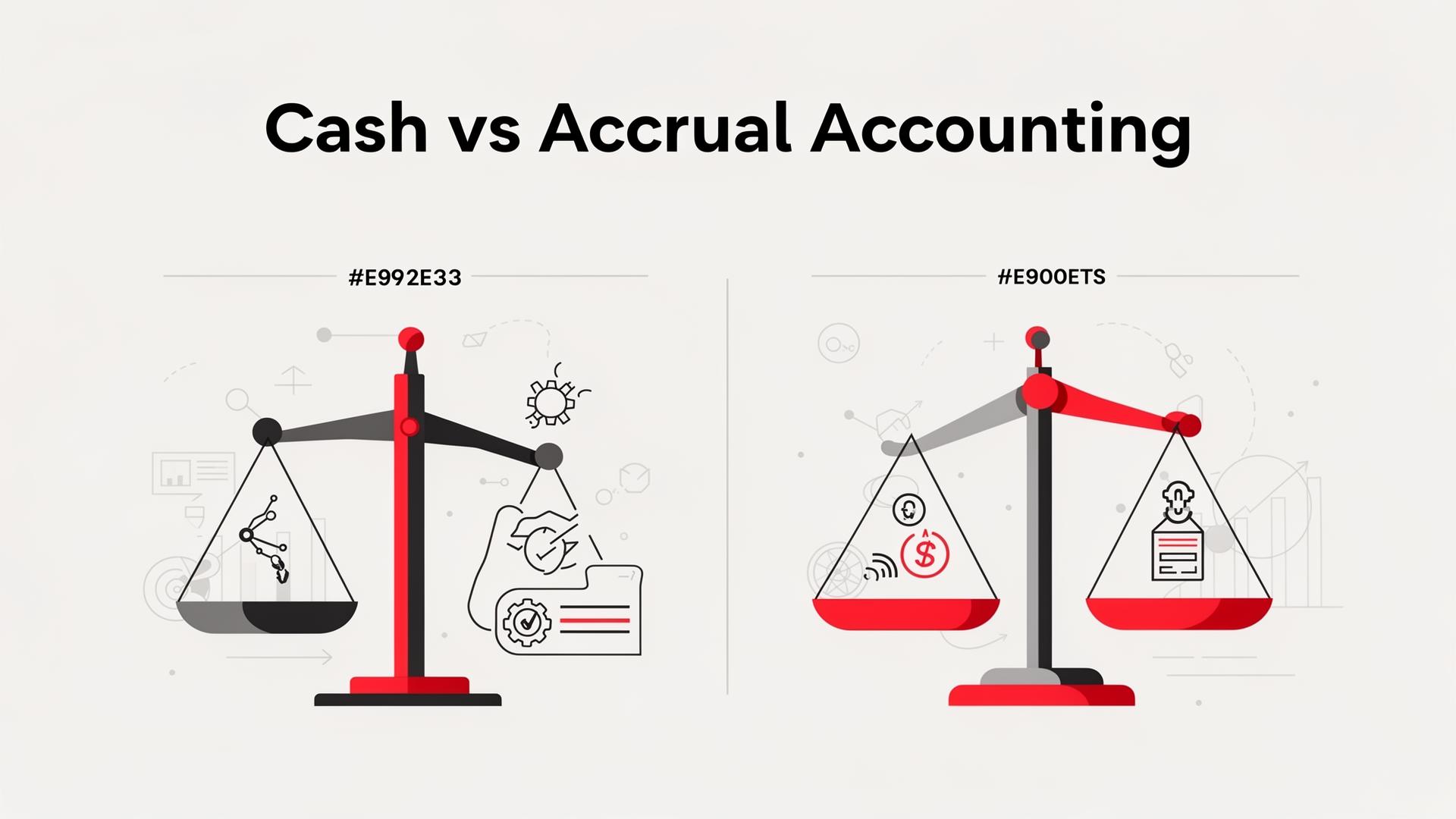
One of the first decisions you'll make is choosing an accounting method. Cash-basis accounting records income when money hits your bank account and expenses when money leaves.
One of the first decisions you'll make is choosing an accounting method. Cash-basis accounting records income when money hits your bank account and expenses when money leaves. It's simpler, more intuitive, and works well for freelancers and small service businesses.
Accrual-basis accounting records income when it's earned (e.g., when you send an invoice) and expenses when they're incurred, regardless of when cash changes hands. It gives a more accurate picture of profitability and is required under Generally Accepted Accounting Principles (GAAP) for most businesses above a certain size. For a deeper comparison, read our guide on cash vs. accrual accounting.
If your business carries inventory, has significant receivables, or plans to seek investment, accrual is the better choice — even if it requires more bookkeeping effort.
Setting Up Your Accounting System
1. Separate Business and Personal Finances
Open a dedicated business bank account and, if relevant, a business credit card. Commingling personal and business funds is the single most common accounting mistake, and it creates nightmares at tax time. Read our detailed guide on why separation matters.
2. Choose Your Accounting Software
Manual spreadsheets work until they don't. Modern tools like Invoicemonk automate categorisation, bank reconciliation, and financial reporting — saving hours each week and reducing errors. The right software also generates the reports your accountant or tax authority needs, without you re-entering data.
3. Build Your Chart of Accounts
Start with standard categories and add specifics for your industry. A design agency might add "Subcontractor Fees" under expenses; a retail business might split revenue into "Online Sales" and "In-Store Sales." Don't over-complicate it — 15 to 25 categories is enough for most small businesses.
4. Establish a Recording Routine
Consistency beats perfection. Set aside 15 minutes daily or one hour weekly to log transactions, scan receipts, and check bank feeds. A regular cadence keeps your books current and prevents the dreaded "shoebox of receipts" crisis in April. For a structured routine, see our monthly financial review checklist.
The Three Essential Financial Reports
Every small business owner should understand — and regularly review — these three reports:
Every small business owner should understand — and regularly review — these three reports:
Income Statement (Profit & Loss): Shows revenue, expenses, and net profit over a period. It answers "Am I making money?" Review it monthly at minimum.
Balance Sheet: A snapshot of assets, liabilities, and equity at a specific date. It answers "What is my business worth right now?" Useful for loan applications and year-end evaluations.
Cash-Flow Statement: Tracks how cash moves in and out of the business through operations, investing, and financing activities. Even profitable businesses can fail if cash flow timing is off — this report catches those problems early. Learn more in our guide to cash-flow forecasting.
Common Accounting Mistakes to Avoid
Mixing personal and business expenses: Muddies your books and can trigger tax audits. Always use separate accounts.
Mixing personal and business expenses: Muddies your books and can trigger tax audits. Always use separate accounts.
Ignoring small transactions: That $12 domain renewal and $9.99 subscription add up. Unrecorded expenses inflate your profit on paper while understating costs, leading to tax surprises.
Waiting until tax season: Cramming a year's worth of bookkeeping into a few weeks produces errors and missed deductions. Do it regularly — daily or weekly — and tax season becomes a non-event.
Not reconciling bank statements: Bank reconciliation catches errors, duplicate charges, and fraud. Match your books to your bank statement monthly. If your accounting software connects to your bank, this can be largely automated.
Skipping backups: Cloud-based tools solve this automatically, but if you use spreadsheets, back up your files regularly. Losing a year of financial records is catastrophic.
When to DIY vs. Hire an Accountant
Most solo freelancers and micro-businesses can handle day-to-day bookkeeping themselves using modern software. But as complexity grows — multiple revenue streams, payroll, international sales, inventory — a professional accountant adds more value than they cost.
Most solo freelancers and micro-businesses can handle day-to-day bookkeeping themselves using modern software. But as complexity grows — multiple revenue streams, payroll, international sales, inventory — a professional accountant adds more value than they cost. For a detailed breakdown, read our guide on DIY vs. hiring.
A common hybrid approach: handle daily bookkeeping yourself and hire an accountant for quarterly reviews and annual tax filing. This keeps costs low while ensuring professional oversight.
Getting Started Today
You don't need to master accounting overnight. Start with three actions: open a separate business bank account, choose an accounting platform that automates the basics, and commit to recording transactions weekly.
You don't need to master accounting overnight. Start with three actions: open a separate business bank account, choose an accounting platform that automates the basics, and commit to recording transactions weekly. Those three steps alone will put you ahead of the majority of small business owners.
Once your system is running, explore related topics like tax-deductible expenses, expense categorisation, and reading financial reports to deepen your financial literacy — and grow your business with confidence.
More in this series (16 articles)
From this series
Essential accounting and expense management knowledge for small business success.
Related Topics
Digital Marketing, SEO Specialist, Content Creator & Product Professional
Olayinka is a digital marketer, content creator, growth and SEO specialist with 10+ years helping businesses in Nigeria, the UK, the US, Australia, and Dubai achieve their goals online.